In this series: Mississippi 2025-26 Enrollment.
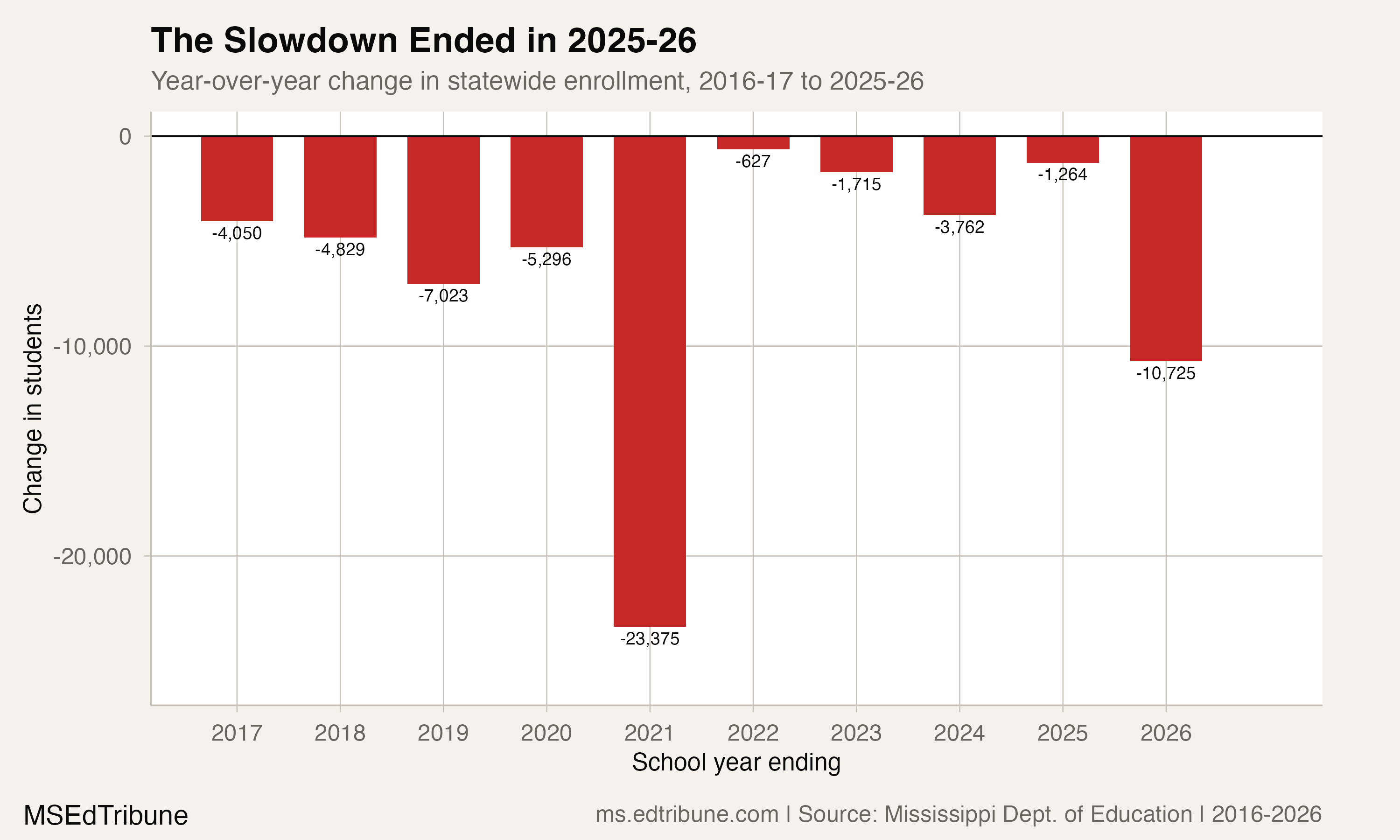
Mississippi's public school enrollment decline had been slowing. Annual losses averaged 1,842 students across the four school years from 2021-22 through 2024-25, far below the disruption that opened the decade. Then the state lost 10,725 students in 2025-26, the most recent school year in the state's published data, an abrupt break from that four-year pattern.
The Mississippi Department of Education does not read that drop as a one-year blip. "MDE identifies the enrollment drop as a trend," Shanderia Minor, a public information officer for the department, wrote in the department's response to questions from The MSEdTribune.
The 2025-26 loss was 8.5 times the prior year's decline of 1,264 students. It was also the largest non-COVID annual loss in the available panel, which runs from 2015-16 through 2025-26. The shift matters for districts because Mississippi's funding system uses net enrollment as part of the calculation that produces weighted enrollment and district allocations.
A slowdown, then a reversal
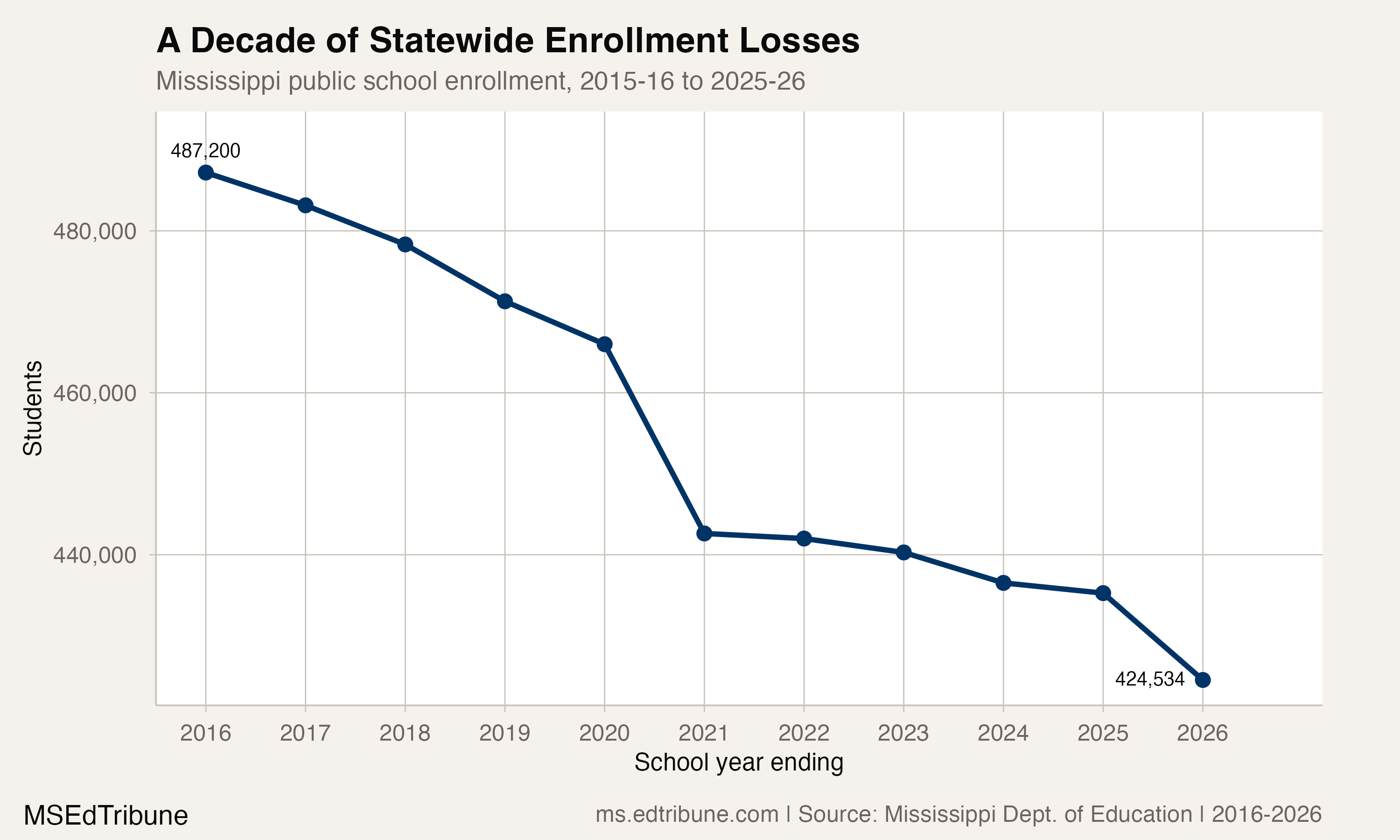
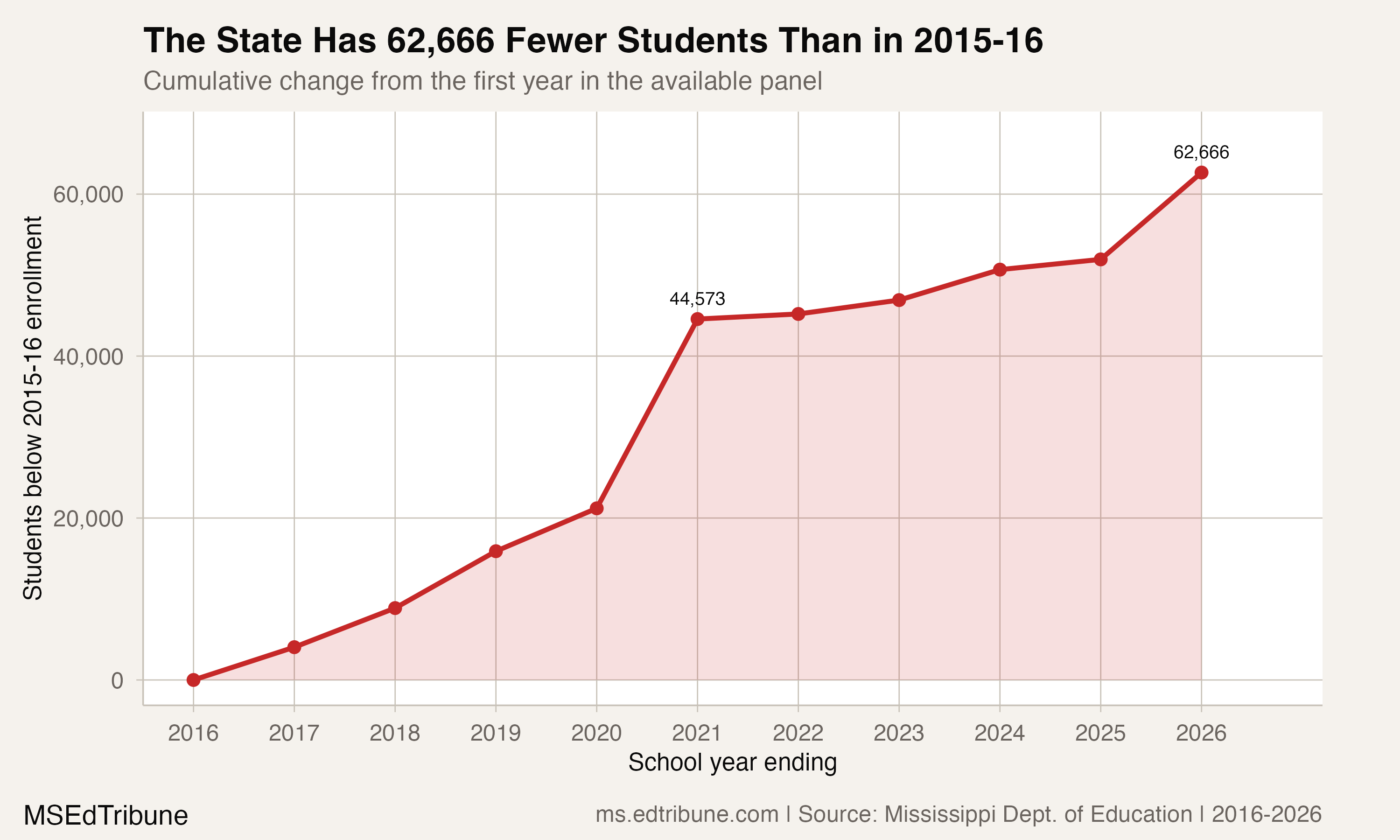
The state's enrollment fell every year in the available panel. Mississippi enrolled 487,200 public school students in 2015-16 and 424,534 in 2025-26. The difference is 62,666 students, or 12.9% of the 2015-16 total, across 10 consecutive annual declines.
Before the pandemic, annual losses ranged from 4,050 to 7,023 students and averaged 5,300. Enrollment then fell by 23,375 students from 2019-20 to 2020-21, a 5.0% single-year decline.
The next four annual losses were smaller. The state lost an average of 1,842 students per year from 2021-22 through 2024-25. That did not amount to growth, but it gave districts a more gradual pattern for staffing, facilities and program decisions. The 2025-26 decline of 10,725 students, or 2.5%, ended that stretch.
Why headcount reaches district budgets
The state Legislature's funding formula summary describes how net enrollment, weighted enrollment and additional student needs enter the allocation calculation.
The department said the effect of a shrinking headcount will not land evenly. "The implications will vary by district," Minor wrote. "Districts with sustained enrollment declines since FY 2024 are likely to experience the greatest effect because MSFF funding is driven largely by student enrollment." Minor added that "districts with declining enrollment, high fixed costs, and limited ability to adjust operations may face greater challenges than districts with stable or growing enrollment."
That structure makes enrollment a budget input, but statewide enrollment loss cannot be translated into a single honest dollar estimate. The department cautioned against treating the formula as a simple per-student count. "The inclusion of weighted categories offers districts a more accurate accounting of costs related to educating children," Minor wrote. "If the funding was relegated to average net enrollment exclusively, districts would not be able to recoup funding associated with total cost of educating children within those weighted categories."
District allocations also reflect local contributions and other formula components. The enrollment data shows the headcount change; it does not establish a uniform amount lost for each student or prove how any district adjusted its budget.
The cumulative decline still defines the scale of the planning problem. Mississippi enrolled 62,666 fewer students in 2025-26 than it did at the start of the panel. Leaders making staffing and facility decisions are working within a system that became smaller in every observed year.
The grade spine points in different directions
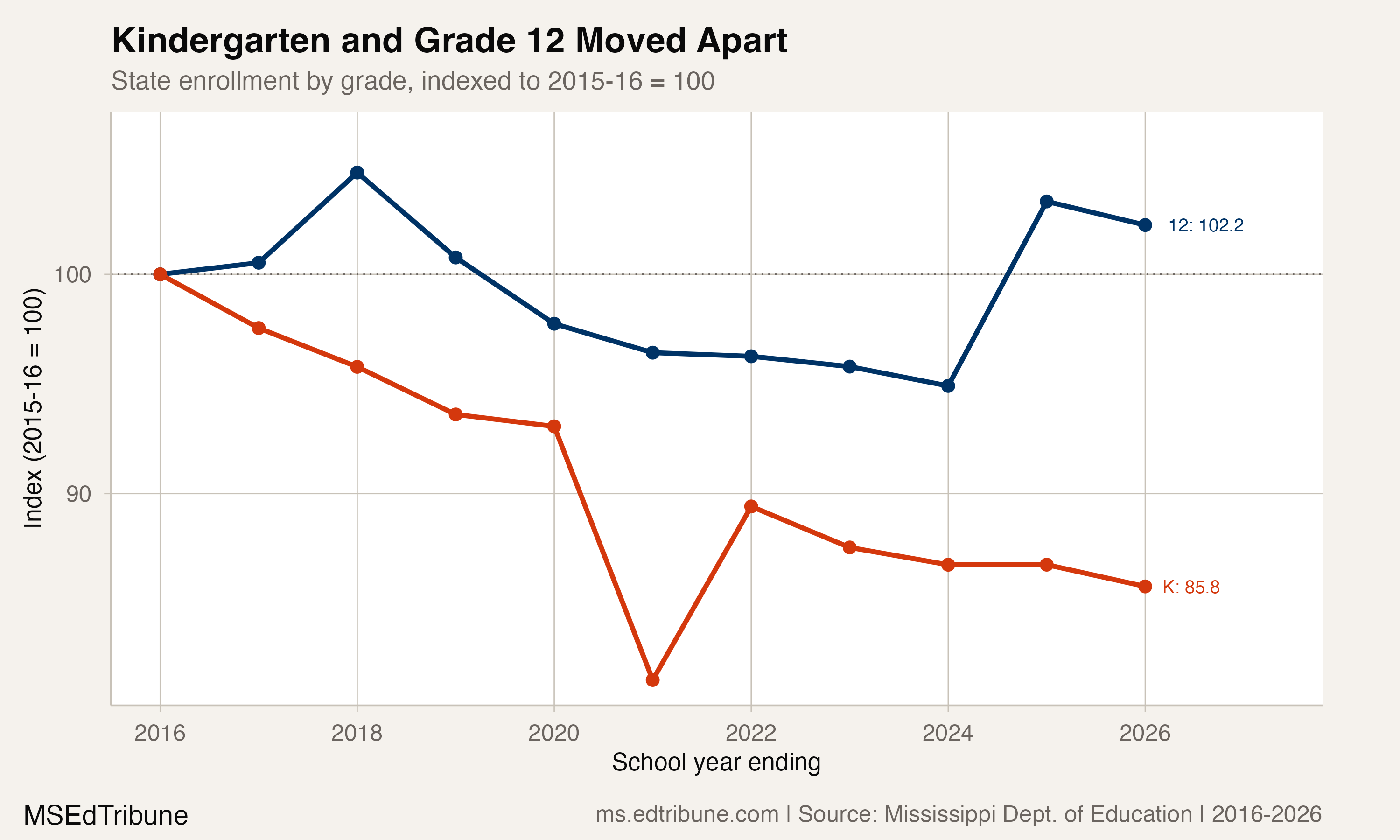
Kindergarten and twelfth grade moved apart over the same period. Statewide kindergarten enrollment fell from 37,573 in 2015-16 to 32,225 in 2025-26, a 14.2% decline. Twelfth-grade enrollment rose from 29,561 to 30,225, an increase of 664 students, or 2.2%.
Those endpoints do not forecast a graduating class or prove what future enrollment will be. They do show that the youngest and oldest measured grades ended the panel on different trajectories. The gap is a planning signal for districts considering grade configurations, building use and staffing, not a projection of an unpublished school year.
Jackson led a broad district decline
The statewide change was spread across most of Mississippi's districts. Among 140 districts with total-enrollment data in both 2015-16 and 2025-26, 125 were smaller at the end of that span than at the start. That is 89.3% of the matched district universe. Only 15 grew.
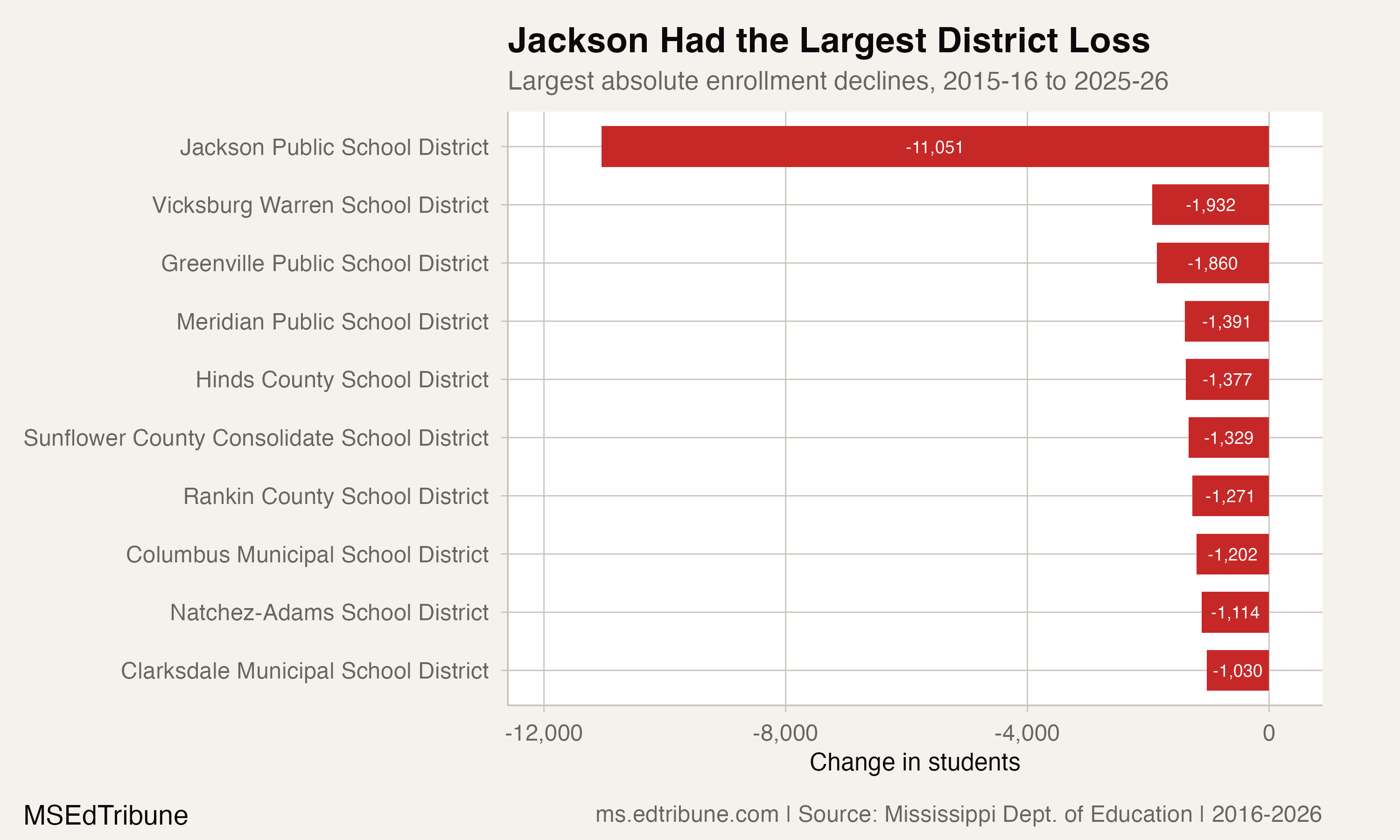
Jackson Public School District↗ET had the largest absolute decline. Its enrollment fell from 28,019 to 16,968, a loss of 11,051 students and a 39.4% contraction. Jackson's decline accounted for 17.6% of the statewide loss.
The pattern was visible elsewhere. Greenville Public School District↗ET declined 34.8%, Vicksburg Warren School District↗ET declined 23.2%, and Meridian Public School District↗ET declined 24.4%.
Among districts with complete data across the full reporting panel, 83 ended 2025-26 at their lowest enrollment in the available records. That wording matters: it is a panel low, not an all-time record, because the comparison begins in 2015-16.
What the enrollment data cannot settle
The department's answer settles how it reads the 2025-26 decline, as part of a trend rather than a counting problem. It does not settle how steep the next phase will be. The state has not yet published 2026-27 enrollment, and districts' own current-year counts will differ from these figures once it does.
The enrollment file does not record whether students moved out of Mississippi, entered private schools, began homeschooling or changed sectors. The totals establish the decline and its size, while leaving those explanations unresolved.
The department said its response is aimed at planning. "MDE encourages districts experiencing enrollment declines to engage in long-term financial planning and align staffing, facilities, and expenditures with projected enrollment trends," Minor wrote. "Through MDE’s Office of School Financial Services, MDE is working to provide technical assistance to help districts plan for the funding changes under Mississippi Student Funding Formula (MSFF)."
What the data does establish is narrower. A four-year period of smaller losses ended with a much larger decline, the youngest measured grade shrank while twelfth grade grew, and most matched districts were smaller than a decade earlier. With the department describing the drop as a trend, the harder question for the districts it singles out, those with sustained declines, high fixed costs and little room to adjust, is how quickly staffing and buildings can follow enrollment down.
Detailed code that reproduces the analysis and figures in this article is available exclusively to EdTribune subscribers.
Discussion
Sign in to join the discussion.
Loading comments...