In this series: Mississippi 2025-26 Enrollment.
Of Mississippi's 152 school districts, 87 enrolled fewer students in 2025-26 than in any previous year on record. That is 57.2% of all districts, the highest share since COVID emptied classrooms in 2020-21.
The difference between then and now: in 2021, the pandemic was a plausible one-time shock. Five years later, the losses have compounded. The 233,139 students attending school in those 87 districts represent 54.9% of the state's total enrollment. More than half of Mississippi's public school students are in a district at its lowest enrollment on record.
A decade of decline with no floor in sight
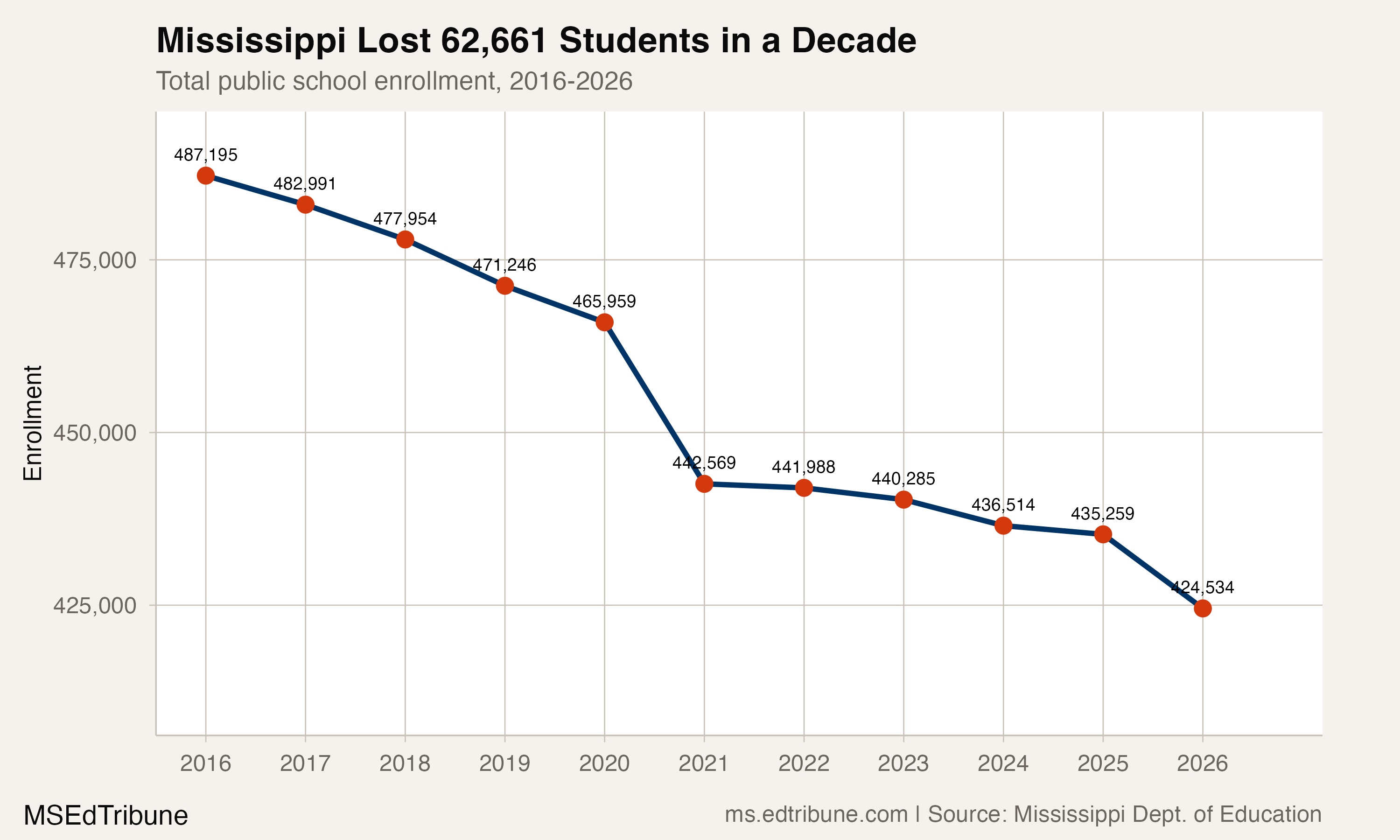
Mississippi enrolled 424,534 public school students in 2025-26, down from 487,195 a decade ago. That 62,661-student loss, a 12.9% decline, has not produced a single year of growth. Every year since 2016 has been smaller than the last.
The 2025-26 drop of 10,725 students, a 2.5% decline, is the steepest non-COVID loss in the dataset. It is nearly double the pre-pandemic average of roughly 5,300 per year and quadruple the 1,255-student loss recorded in 2024-25. Something shifted between last year and this one, and the cause is not immediately clear from enrollment data alone.
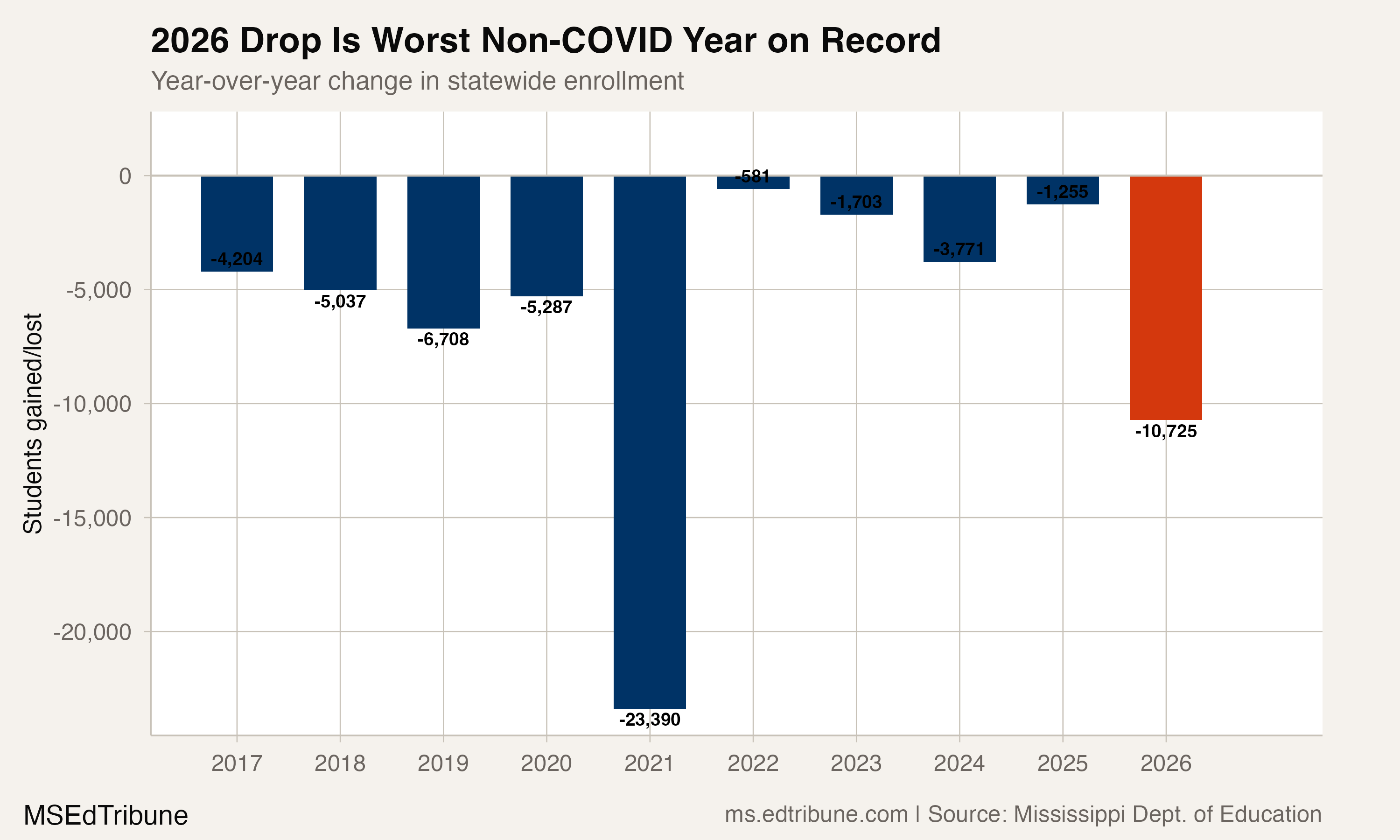
The year-over-year pattern shows a state that appeared to stabilize after COVID. From 2022 through 2025, annual losses ran between 581 and 3,771 students. Then 2026 broke the trend. The post-pandemic plateau was not a floor.
Where the losses are concentrated
In 2025-26, 125 of 152 districts shrank. Only 26 grew. The 10 largest single-year losers accounted for 4,594 of the 10,725-student statewide decline, or 42.8%.
Rankin County↗ET lost the most students in a single year: 1,083, a 5.7% drop that pushed it to 17,963 students, its all-time low. Jones County lost 726. Jackson Public Schools↗ET, already in long-term freefall, shed another 592.
Even districts that had been growing reversed. DeSoto County↗ET, the state's largest district and one of only 15 to gain students over the decade without a consolidation, dropped by 493 in a single year. Oxford fell by 210. Lamar County lost 436. These are suburban and exurban districts that had been absorbing families leaving the state's urban cores.
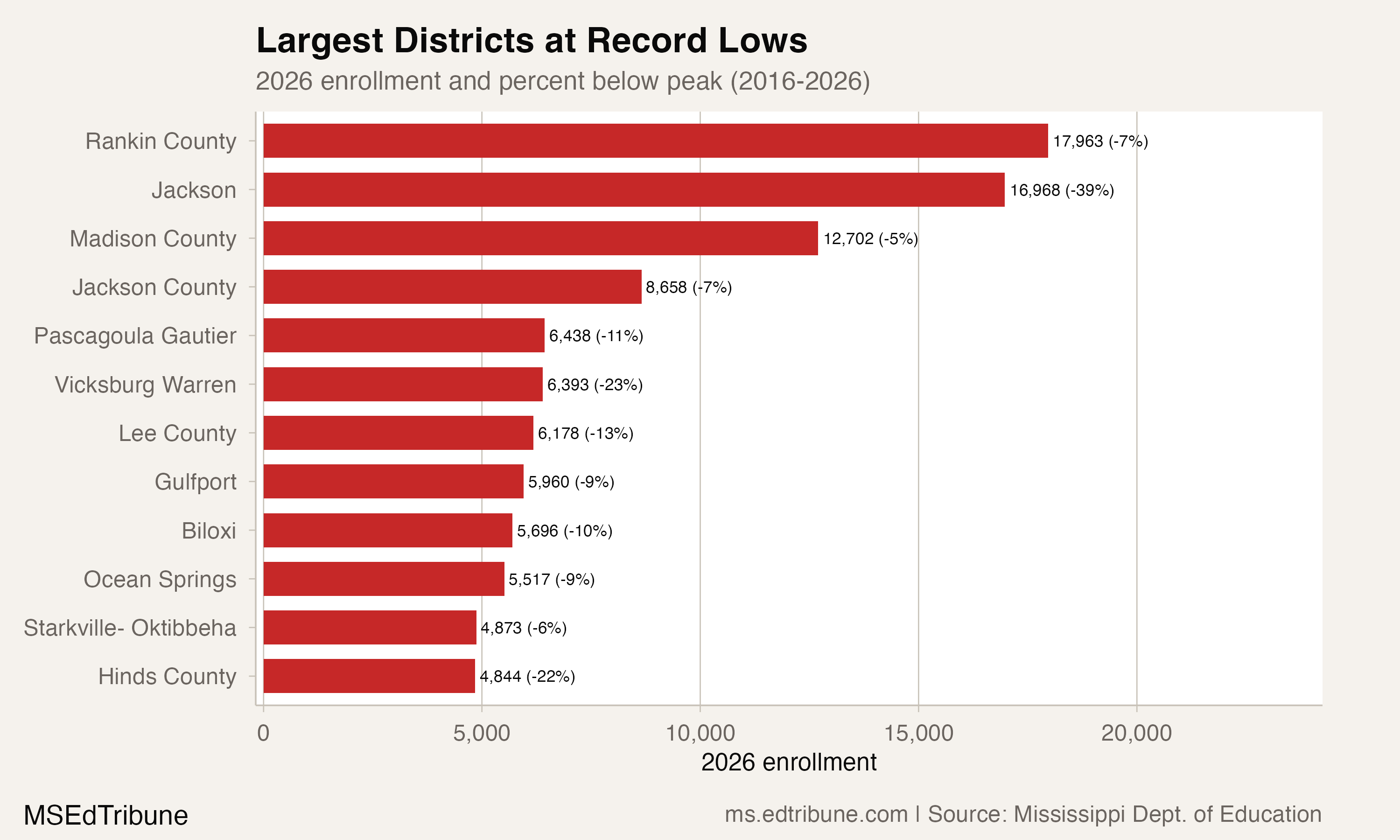
Among the 87 districts at record lows, 12 enroll more than 4,800 students. Jackson sits 39.4% below its 2016 level. Vicksburg Warren↗ET is down 23.2%. Hinds County↗ET has lost 22.1%. Meridian↗ET is down 24.4%. These are not small rural systems on the margins of viability. They are the backbone of the state's public school infrastructure.
13 districts that never stopped shrinking
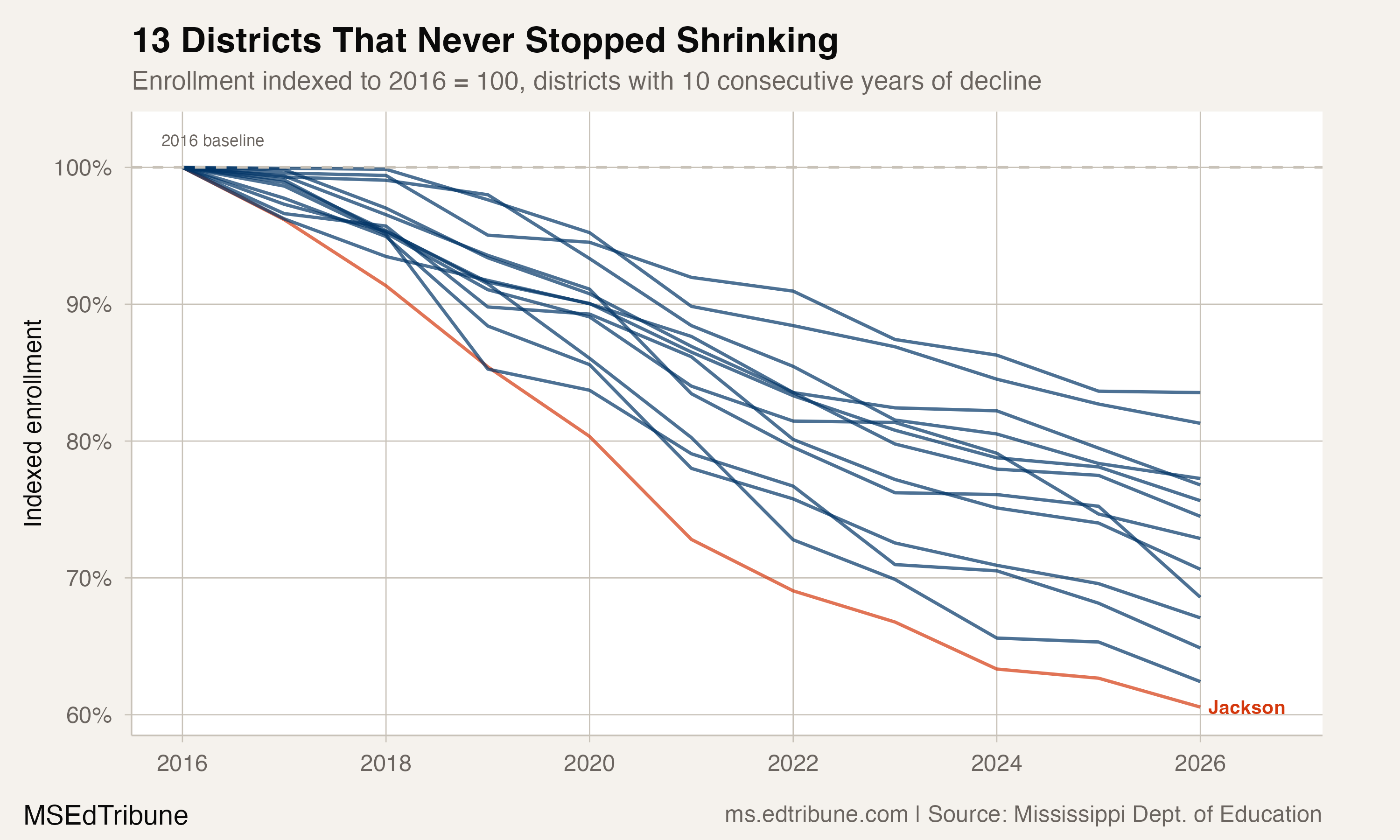
Thirteen districts have declined every single year for 10 consecutive years, the full length of the dataset's year-over-year history. Not one of them has posted even a single year of growth since 2016.
Jackson is the starkest case. The district enrolled 28,019 students in 2015-16 and 16,968 in 2025-26, a loss of 11,051 students, or 39.4%. Jackson Public Schools closed 13 schools before the 2024-25 school year in response to the sustained contraction.
"How long can we just keep putting off what needs to be done, should've been done? We've made good strides, and I don't want to see us go backwards because we're trying to stretch out something that's really not there." Board Member Barbara Hilliard, American School & University, 2024
The other 12 districts on the decade-long decline list are concentrated in the Delta and central Mississippi: Sunflower County (down 32.9%), Humphreys County (down 37.6%), North Bolivar (down 35.1%), Claiborne County (down 29.4%), Vicksburg Warren (down 23.2%), Meridian (down 24.4%), West Point (down 25.5%), Lawrence County (down 31.4%), Quitman (down 27.1%), Calhoun County (down 22.7%), Leake County (down 18.7%), and Louisville (down 16.5%). Together, these 13 districts enrolled 45,407 students in 2025-26, down from 66,261 a decade ago. They have collectively lost 20,854 students.
The structural forces behind the shrinking
Mississippi's enrollment decline tracks closely with broader population loss. Between 2010 and 2021, the number of residents ages 5 to 19 declined by 6.6% due to a combination of outmigration and falling birth rates. The state's births dropped from roughly 40,000 per year in 2010 to 35,000 by 2022, while deaths rose to match, eliminating the natural population increase that once kept the state's headcount stable.
The Jackson metro area has been particularly hard-hit. Census estimates show the city of Jackson lost roughly 9,300 residents between 2020 and 2023 alone, a 6.1% decline. That pattern is visible in Jackson Public Schools' trajectory: a 39.4% enrollment decline that no amount of school consolidation can offset.
Post-pandemic alternatives to traditional public school also play a role, though the data cannot isolate their exact contribution. Homeschooling participation in Mississippi surged by 11.6 percentage points between May and September 2020, more than double the national rate. How many of those families returned is unknown. Mississippi's current ESA program serves only about 345 students with special needs, too small to move the needle, and 2026 proposals to expand eligibility failed in committee.
The funding question
Enrollment loss has fiscal consequences, though Mississippi's funding landscape shifted in 2024. The state replaced its longstanding Mississippi Adequate Education Program (MAEP), which had been underfunded for 16 consecutive years to a cumulative shortfall of $3.5 billion, with the new Mississippi Student Funding Formula. Under either formula, per-pupil funding follows students. Districts losing enrollment lose revenue.
The timing compounds the pressure. Federal ESSER pandemic relief funds, which totaled roughly $1.5 billion in the final round alone, expired in 2024. Districts that used ESSER dollars to maintain staffing levels despite enrollment losses now face a double squeeze: the federal cushion is gone, and the enrollment decline is accelerating.
"The impact of decreased funding will be particularly acute for 'property-poor' districts, due to the structure of the [funding] program." Mississippi First
Property-poor districts, which are disproportionately rural and disproportionately in the Delta, are the same districts most likely to appear on the all-time-low list. The median Black student share in all-time-low districts is 57.8%, compared to 40.0% in districts not at record lows. The enrollment crisis and the equity gap are not separate problems.
The seven exceptions
Only seven districts in the state posted all-time-high enrollment in 2025-26. One is a traditional school district: New Albany Public Schools, which enrolled 2,191 students, modestly above its previous peak. The other six are charter or charter-like entities, including Ambition Preparatory (641 students), Joel E. Smilow Collegiate (583), Midtown Public Charter School (492), and Revive (455). Their combined enrollment is 4,668.
These growth stories are real, but they do not offset the scale of the decline. DeSoto County, the one large district that gained students over the full decade, added 1,375 between 2016 and 2026, a 4.1% increase. Set against a statewide loss of 62,661, even the brightest spot barely registers.
After the record
The 2025-26 enrollment drop arrived faster and steeper than the post-COVID trajectory suggested. If the state loses another 10,000 students in 2027, Mississippi will drop below 415,000 for the first time in at least a generation. The 87 districts already at record lows have no margin left.
The 13 districts that have declined every single year since 2016 are not going to reverse course. Their remaining question is operational: at what enrollment level does a district need to consolidate schools, share superintendents, or merge with a neighbor? The legislature's new school choice proposals and the ongoing exodus from the Delta and Jackson metro are not causing the decline. They are shaping what Mississippi's school map looks like when it stabilizes.
Detailed code that reproduces the analysis and figures in this article is available exclusively to EdTribune subscribers.
Discussion
Sign in to join the discussion.
Loading comments...