In this series: Mississippi 2025-26 Enrollment.
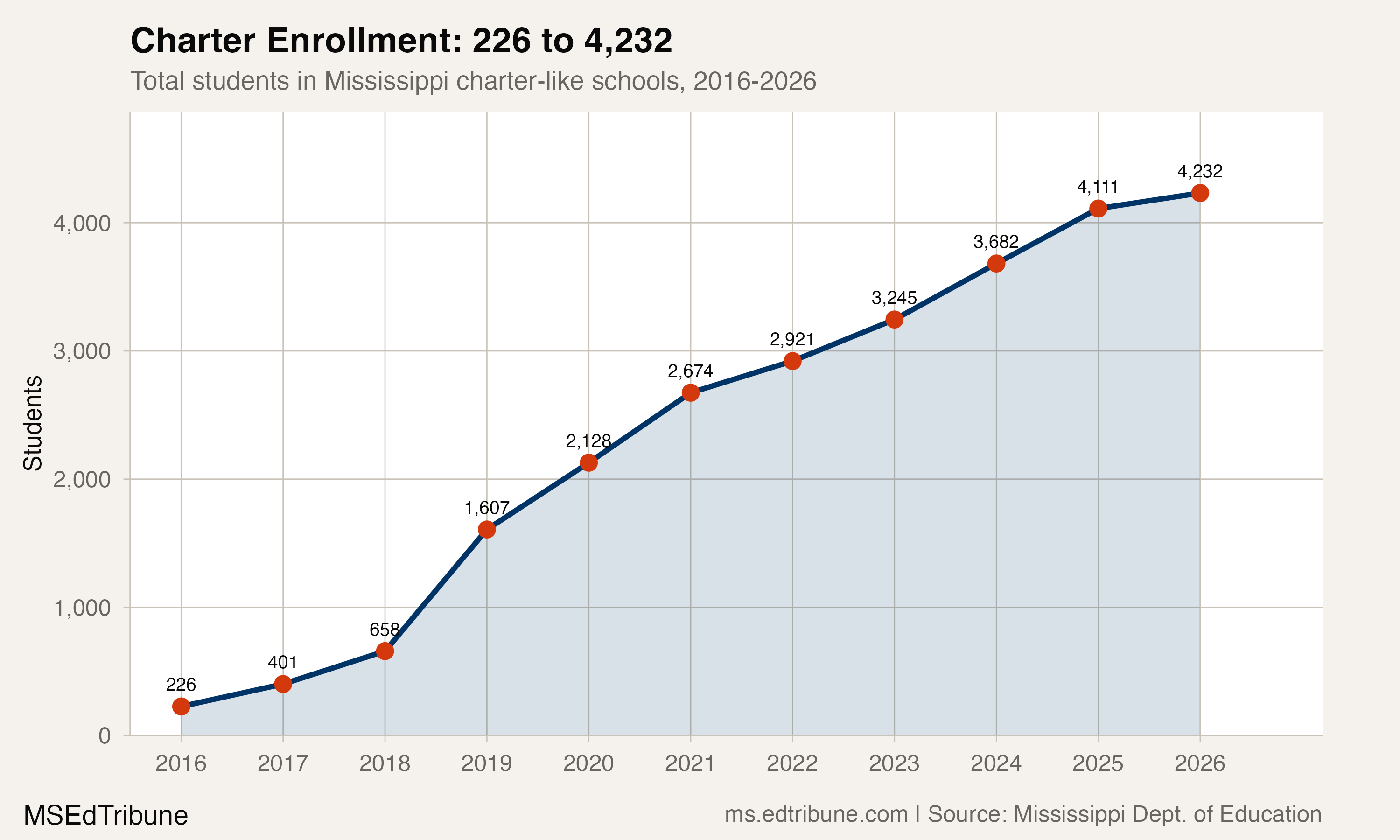
Ten charter schools serve 4,232 students in Mississippi. That is 1.0% of the state's 424,534 total enrollment, a figure so small it barely registers in a statewide data table.
But charter schools do not operate statewide. Mississippi's 2013 charter law restricts them to school districts rated "D" or "F" by the state, concentrating them overwhelmingly in Jackson and the Mississippi Delta. In those communities, the math looks different. Of the combined enrollment pool of Jackson Public Schools and the city's six charter schools, charters now account for 15.3%, up from 0.8% a decade ago. In a district already closing 13 buildings, charter schools have become a significant force.
From 226 to 4,232 in a decade
Mississippi's charter sector began in 2016 with two schools and 226 students: Midtown Public Charter School (106 students) and Reimagine Prep (120). The sector has grown every year since, multiplying 18.7 times over. Three waves of new school openings drove the expansion: three schools launched in 2019, one in 2021, one in 2023, and two more in 2024-2025. By 2026, the 10 operating charter schools enrolled 4,232 students.
The growth trajectory has an important asterisk. Year-over-year charter gains have slowed sharply, from a 144.2% surge in 2019 (when three new schools opened simultaneously) to just 2.9% in 2026. That 121-student gain is the smallest annual increase in the sector's history, and it came in a year when the state lost 10,725 students overall. No new charter schools opened in 2026, which partly explains the deceleration.
Statewide, charter enrollment crossed 1.0% of total enrollment for the first time in 2026. For context, 7.6% of U.S. public school students attended charter schools in 2022, making Mississippi's 1.0% one of the smallest charter sectors in the country.
The Jackson story: one in seven
Statewide statistics obscure what is happening inside Jackson. Six of the 10 charter schools are located in the Jackson metro area: Reimagine Prep, Joel E. Smilow Collegiate, Smilow Prep, Ambition Preparatory, Midtown Public Charter School, and Revive. Together they enrolled 3,059 students in 2026.
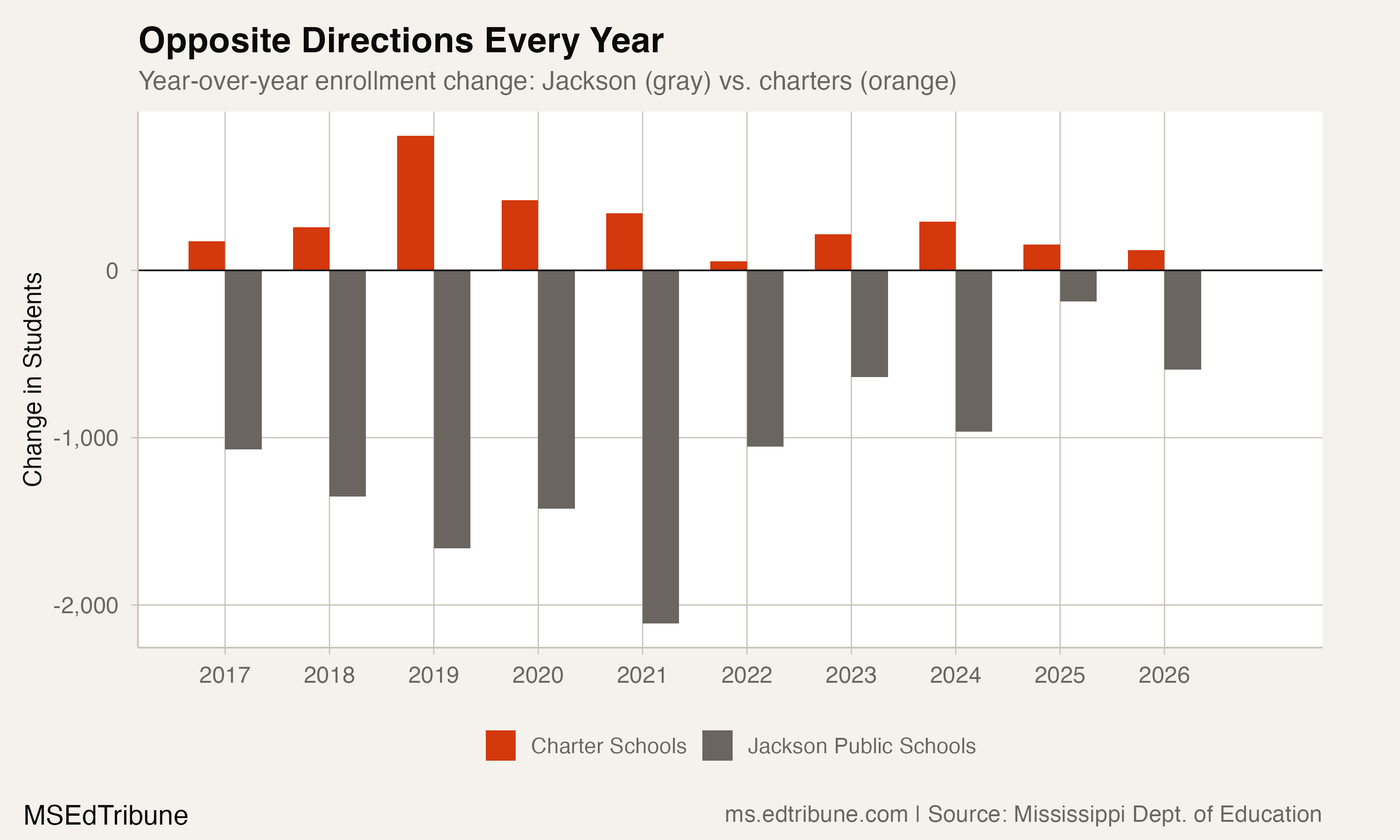
Jackson Public School District enrolled 16,968 students that same year, down from 28,019 in 2016. The district has lost 11,051 students, 39.4% of its enrollment, in a decade. The six Jackson-area charter schools gained 2,833 students over the same period, absorbing 25.6% of Jackson's raw enrollment loss.
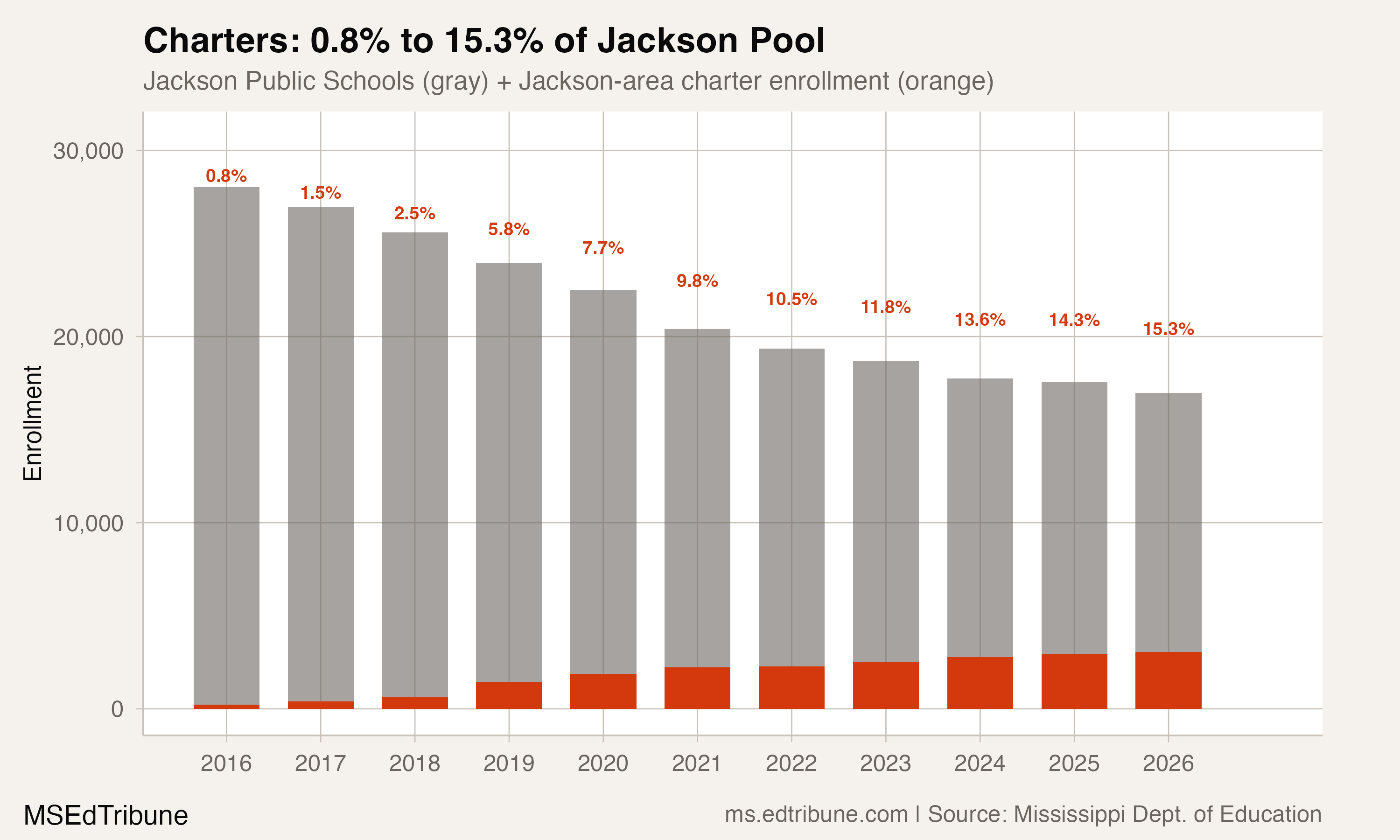
The charter-to-Jackson ratio has climbed steadily: 0.8% in 2016, 5.8% in 2019, 9.8% in 2021, and 15.3% in 2026. But attributing Jackson's decline entirely to charter competition would be misleading. Jackson Public Schools Superintendent Errick Greene, explaining the district's decision to close 13 schools, cited declining enrollment, staff shortages, and the cost of maintaining aging buildings. He compared the district's predicament to "a diabetic facing amputation."
"If we do not take drastic action right now...we could create a situation where our system cannot survive." -- Mississippi Free Press, Dec. 2023
The district's enrollment loss predates the charter sector's meaningful presence. Jackson lost 4,084 students between 2016 and 2019, when charters still enrolled fewer than 1,700. Outmigration to suburban districts, private schools, and homeschooling accounts for a substantial share of the decline. Mississippi First, a nonpartisan education policy organization, attributes the broader statewide trend to outmigration and declining birth rates, noting that the state's 5-to-19 age group shrank 6.6% between 2010 and 2021.
Who the charter schools serve
The demographic profile of charter enrollment is striking. Of 4,232 charter students in 2026, 3,967 are Black, a 93.7% share. White students account for 44 (1.0%). Statewide, Black students make up 45.1% of enrollment and white students 40.5%. The charter sector's demographics reflect not a statewide cross-section but the specific communities where charters are authorized to operate: Jackson (91.9% Black in the public schools) and Delta towns like Clarksdale and Greenville.
This concentration is a direct product of the law's design. By limiting charters to "D" and "F" rated districts, Mississippi effectively restricted them to majority-Black communities with the lowest-performing schools. Whether that represents targeted intervention for the students who need it most or a two-tier system that bypasses investment in traditional schools depends on whom you ask.
Diverging paths within the sector
Not all charter schools are on the same trajectory. Three are growing aggressively, two are in sustained decline, and the rest are stable or fluctuating.
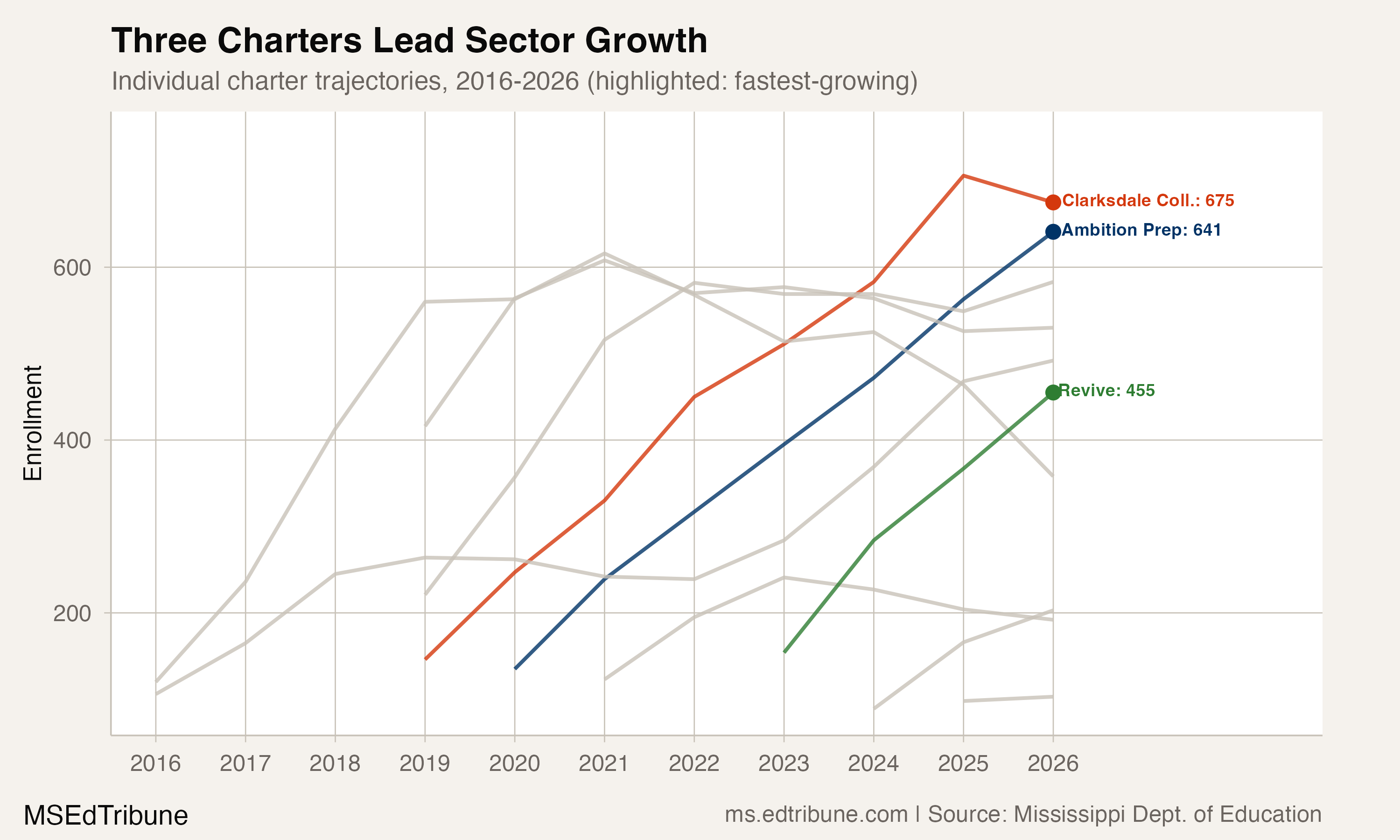
Ambition Preparatory, a K-7 school, grew from 135 students in 2020 to 641 in 2026, a 374.8% increase. Its executive director, DeArchie Scott, told the Mississippi Free Press that the school was approved to add a high school starting in 2027, noting: "Our families have been concerned about where their children would go for high school for years now."
Clarksdale Collegiate, the first charter outside Jackson, grew from 146 students in 2019 to 675 in 2026 (362.3%). It too has been approved to expand to high school grades, becoming the state's first 9-12 charter school in fall 2025.
Revive, a K-4 school, has nearly tripled from 154 to 455 students since 2023.
On the other side, Reimagine Prep peaked at 616 students in 2021 and has since declined 41.9% to 358. Leflore Legacy Academy, a middle school in Greenwood, has lost students in three of its five years of operation, falling from a peak of 241 to 192. The Mississippi Charter School Authorizer Board renewed Reimagine Prep's charter for another five years. The enrollment decline may reflect capacity decisions by the operator, Nashville-based RePublic Schools, which also runs Smilow Prep and Joel E. Smilow Collegiate.
The missing high school
The grade distribution reveals the charter sector's most significant structural limitation. Of 4,232 charter students, exactly 69 are in 9th grade. Zero are in 10th, 11th, or 12th. Every charter school in Mississippi is a K-8 operation (or a subset of those grades). Before 2025-26, no Mississippi charter school had a high school grade in operation.
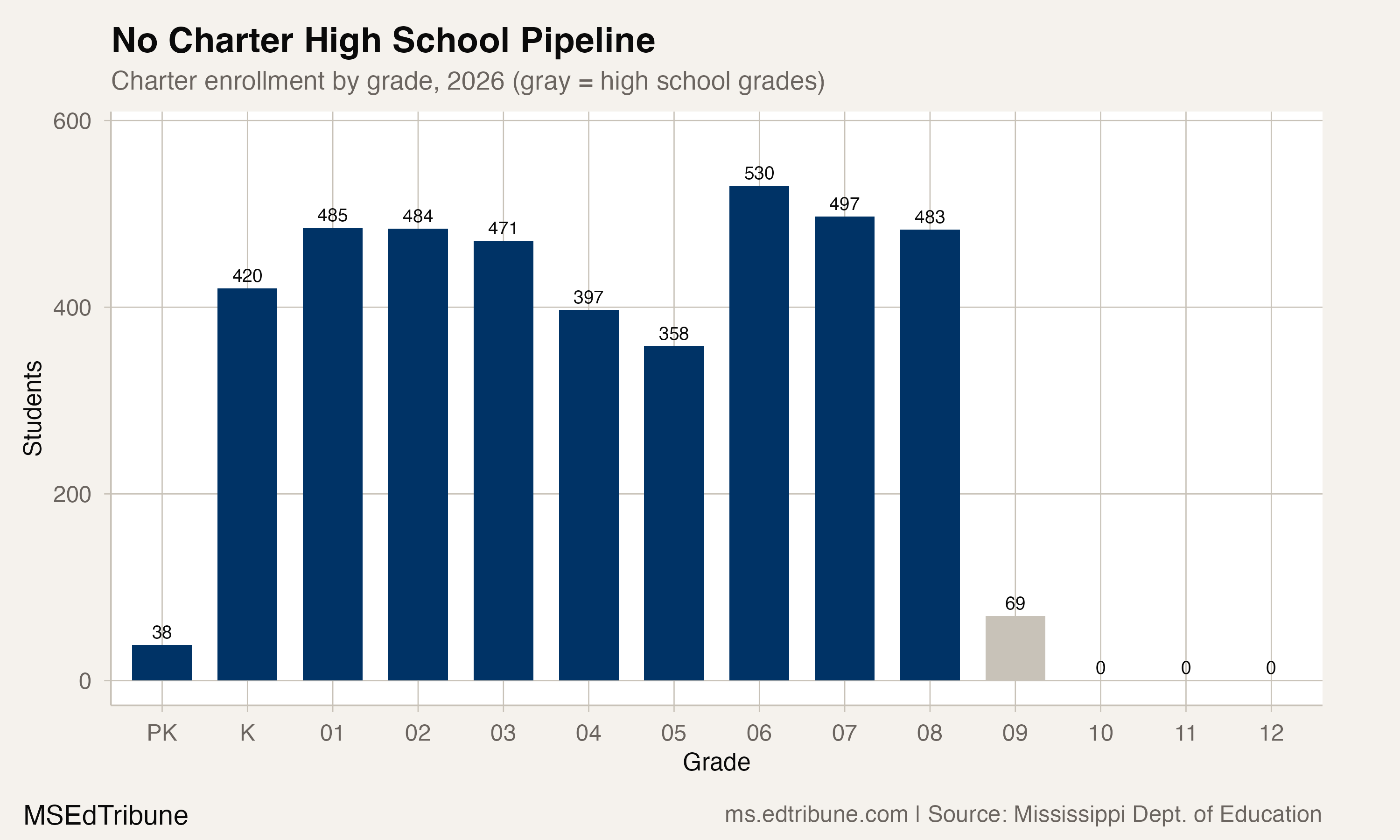
That began changing in fall 2025. Clarksdale Collegiate Prep opened its first 9th-grade class, and Ambition Preparatory was approved for high school expansion starting in 2027. The Mississippi Charter School Authorizer Board's Lisa Karmacharya called the Ambition expansion "a game changer," noting that families will be able to continue the charter pathway through graduation.
The absence of high school options means every charter student in Mississippi eventually returns to the traditional district system or leaves public schooling altogether. For Jackson Public Schools, that creates a peculiar dynamic: the district loses students to charters in elementary and middle school, then receives some of them back in 9th grade. Whether those returning students are better prepared is a question the enrollment data cannot answer.
A legislative battle over the sector's future
The 2026 Mississippi legislative session brought the charter sector's future into sharp focus. The Mississippi House passed House Bill 2, a 446-page omnibus bill that would have expanded charter authorization beyond "D" and "F" districts, created education savings accounts, and restructured the Authorizer Board. The bill passed the House 61-59 but was killed by the Senate Education Committee in a meeting lasting less than two minutes in February 2026.
The legislative fight matters because the current law caps the charter sector's addressable market. Charters can only open in districts rated "D" or "F." If a district's rating improves, the authorization environment tightens. A 2025 House bill that would have extended eligibility to "C" rated districts also died in committee.
Meanwhile, the Authorizer Board approved two new charter schools in October 2024: Archway Charter School in Humphreys County and Mississippi Global Academy in the Bolivar County Delta. Current charter listings place both schools in the 2026 opening cohort, with Mississippi Global Academy describing a fall 2026 opening.
A sector at a crossroads
The charter sector's 2.9% growth in 2026 is its weakest year ever. Whether that represents a natural plateau for a constrained sector, a one-year pause before new school openings add capacity, or the beginning of a slowdown in demand will become clear in 2027, when Archway and Mississippi Global Academy report their first enrollment numbers.
The more consequential question is whether charter high schools change the sector's dynamics. If Clarksdale Collegiate Prep and eventually Ambition Prep retain their K-8 students through graduation, the sector's enrollment ceiling rises substantially. If families choose traditional high schools instead, the charter model remains a middle-school intervention in a state where it was designed, by law, to serve the lowest-performing communities.
Detailed code that reproduces the analysis and figures in this article is available exclusively to EdTribune subscribers.
Discussion
Sign in to join the discussion.
Loading comments...