In this series: Mississippi 2025-26 Enrollment.
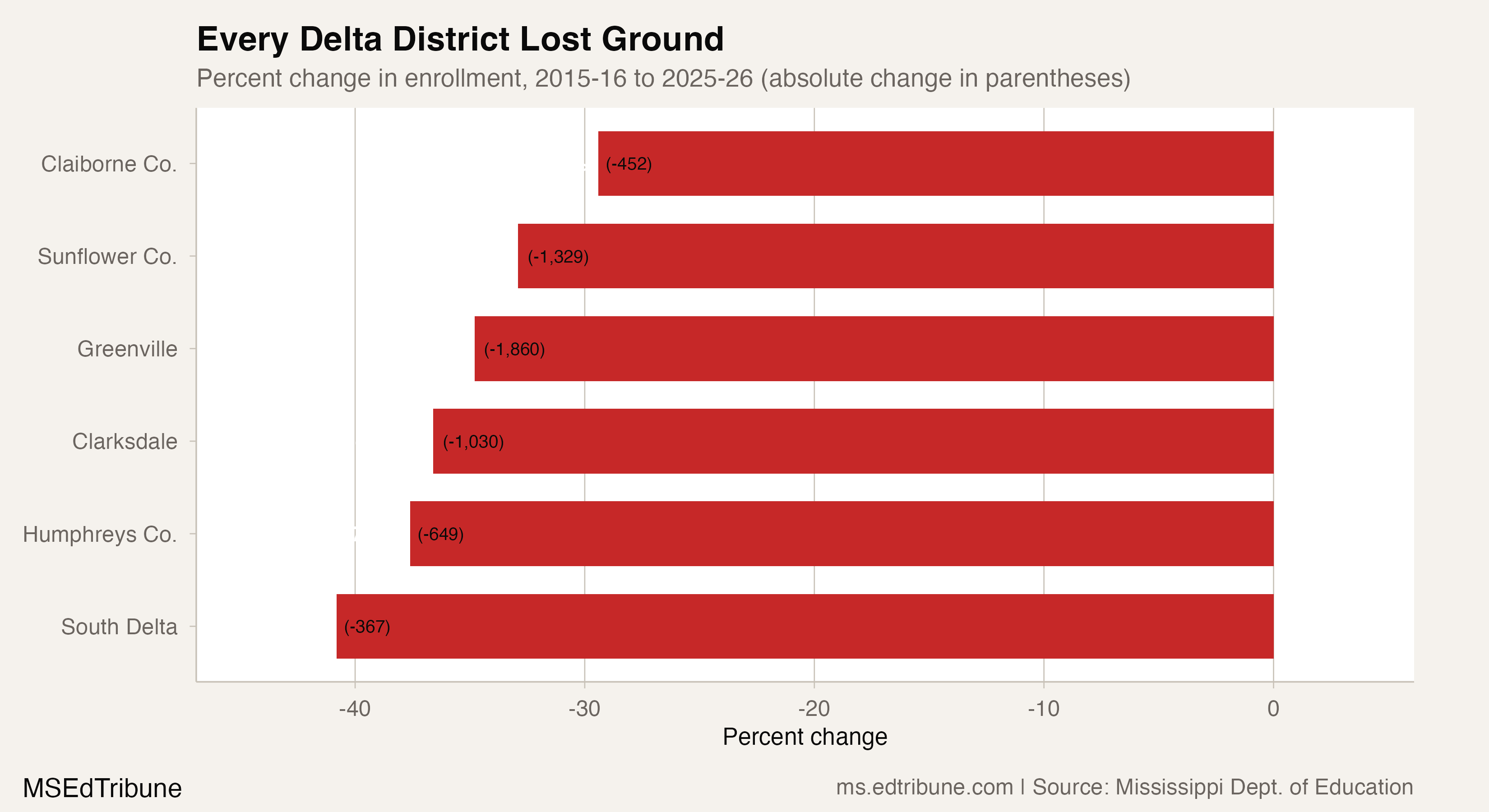
South Delta School District enrolled 899 students in 2015-16. By 2025-26, that number had fallen to 532, a loss of 40.8%. It is not alone. Five neighboring districts in the Mississippi Delta have followed the same trajectory, and only one of them, Greenville, has posted even a single year of growth in the past decade.
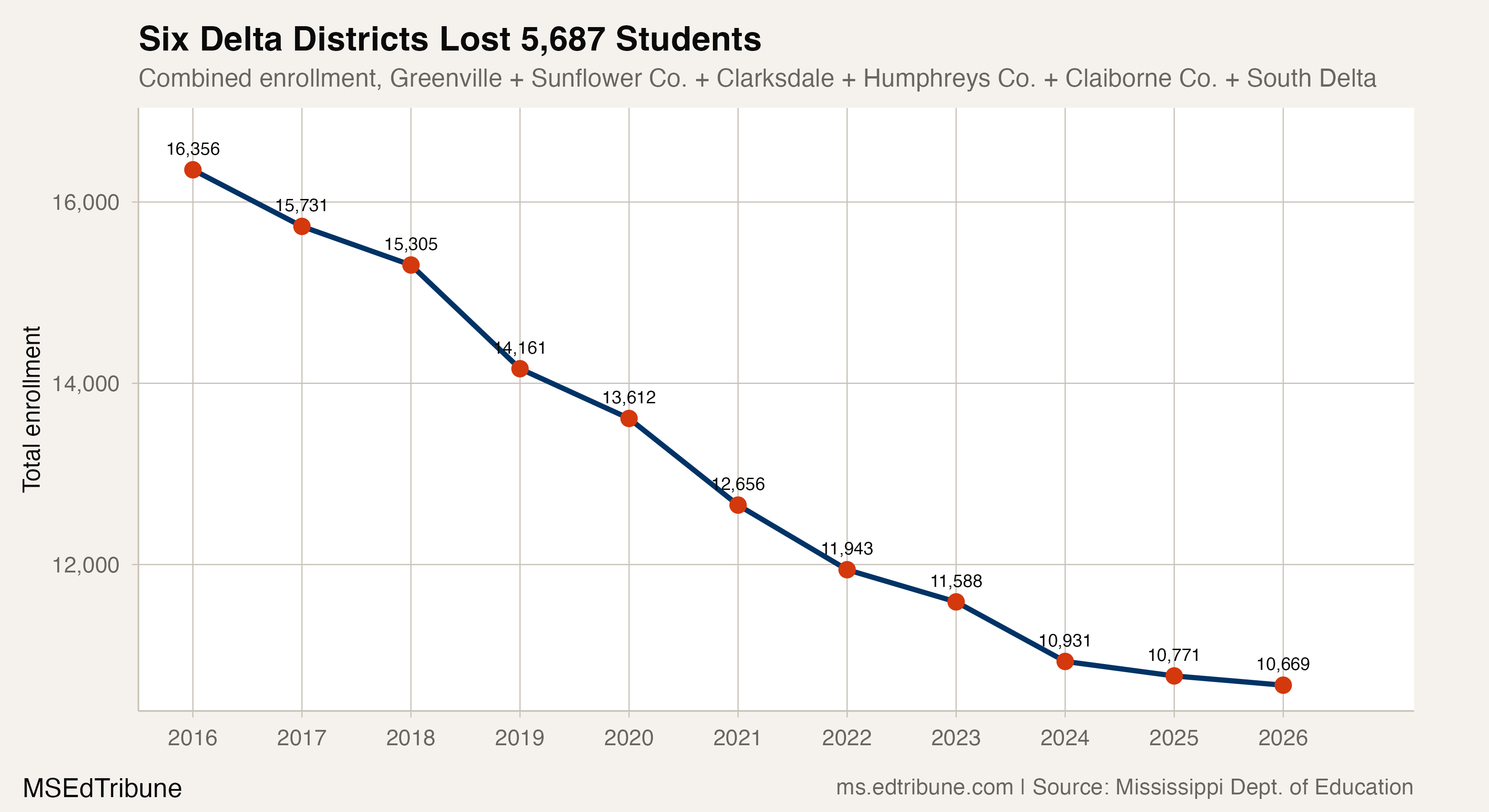
Together, these six districts enrolled 16,356 students in 2015-16. They now enroll 10,669, a combined loss of 5,687 students, or 34.8%. Mississippi as a whole lost 12.9% of its public school enrollment over the same period. The Delta is emptying 2.7 times faster than the state.
Where the students went
The decline is not concentrated in one district. It is distributed across all six, running from South Delta↗ET's 40.8% loss to Claiborne County↗ET's 29.4%. Greenville↗ET, the largest of the group with 3,482 students remaining, has lost 1,860 students since 2016, more than any other Delta district in absolute terms. Clarksdale↗ET lost 1,030. Sunflower County↗ET lost 1,329. Humphreys County↗ET lost 649.
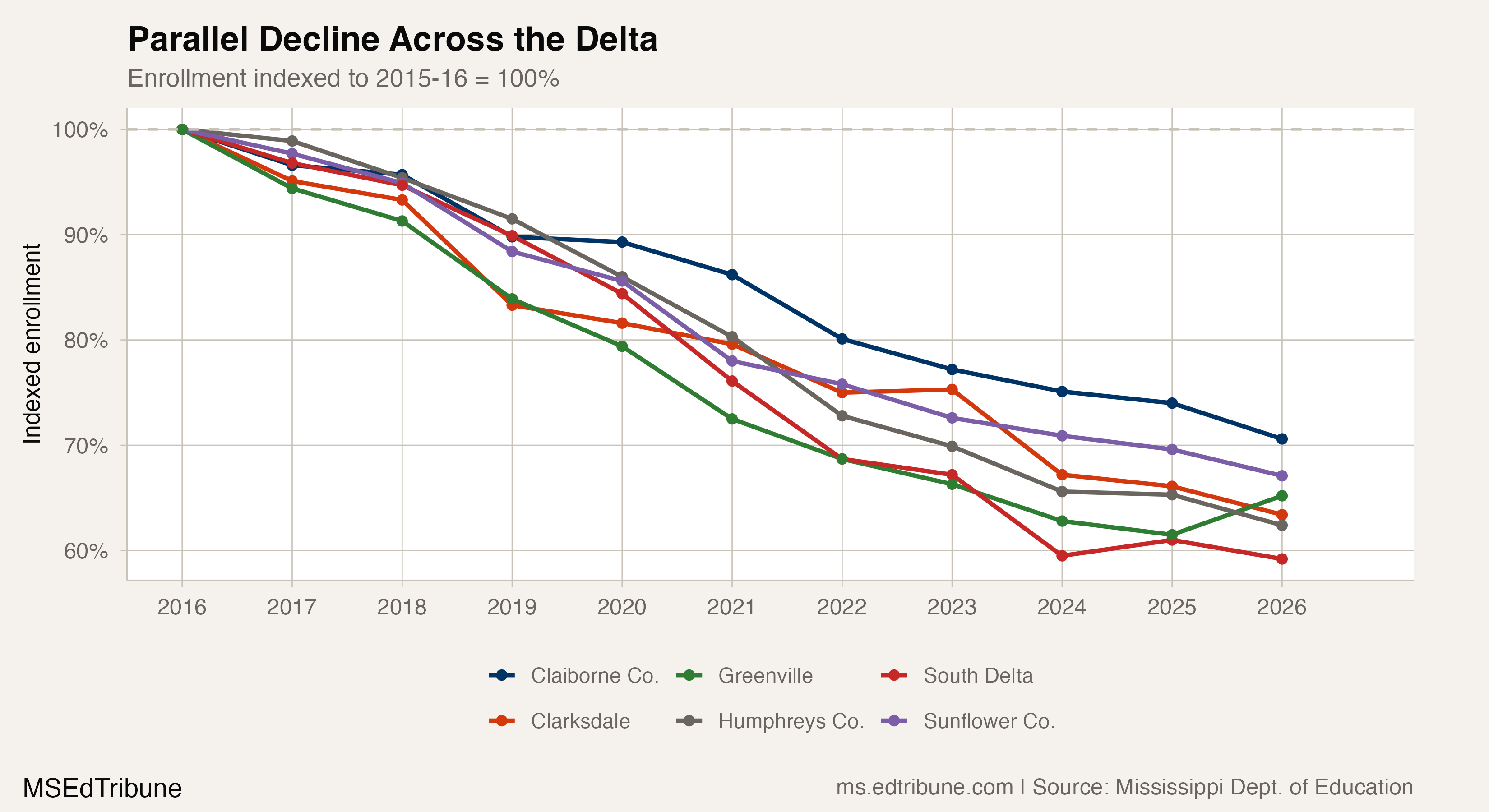
When indexed to their 2015-16 baselines, all six districts track a strikingly similar decline curve. South Delta dropped fastest, but the trajectories are parallel: each district losing roughly 3% to 7% of its enrollment every year, grinding downward without interruption. Greenville posted a small uptick in 2025-26, gaining 194 students after eight consecutive years of losses. School-level data suggests this reflects an internal consolidation at Greenville High School, which jumped from 845 to 1,143 students, rather than new families arriving.
A region losing its young
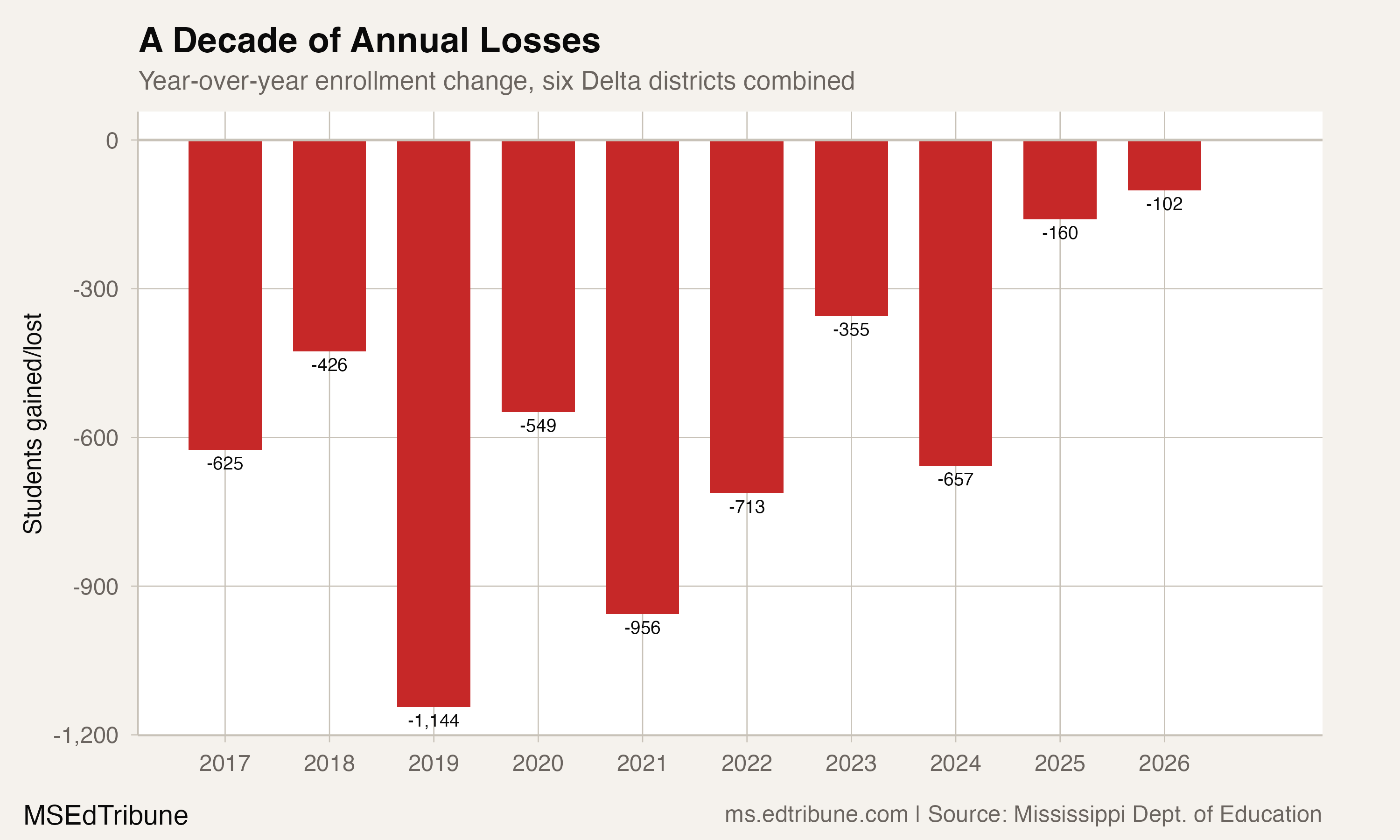
The year-over-year pattern reveals that the worst single-year loss came in 2018-19, when these six districts shed 1,144 students, a 7.5% drop. The pandemic year of 2020-21 brought another 956-student loss, or 7.0%. Since then, annual losses have been smaller in absolute terms, but that is partly arithmetic: there are fewer students left to lose. The 102-student decline in 2025-26 represents the smallest annual loss on record for this group.
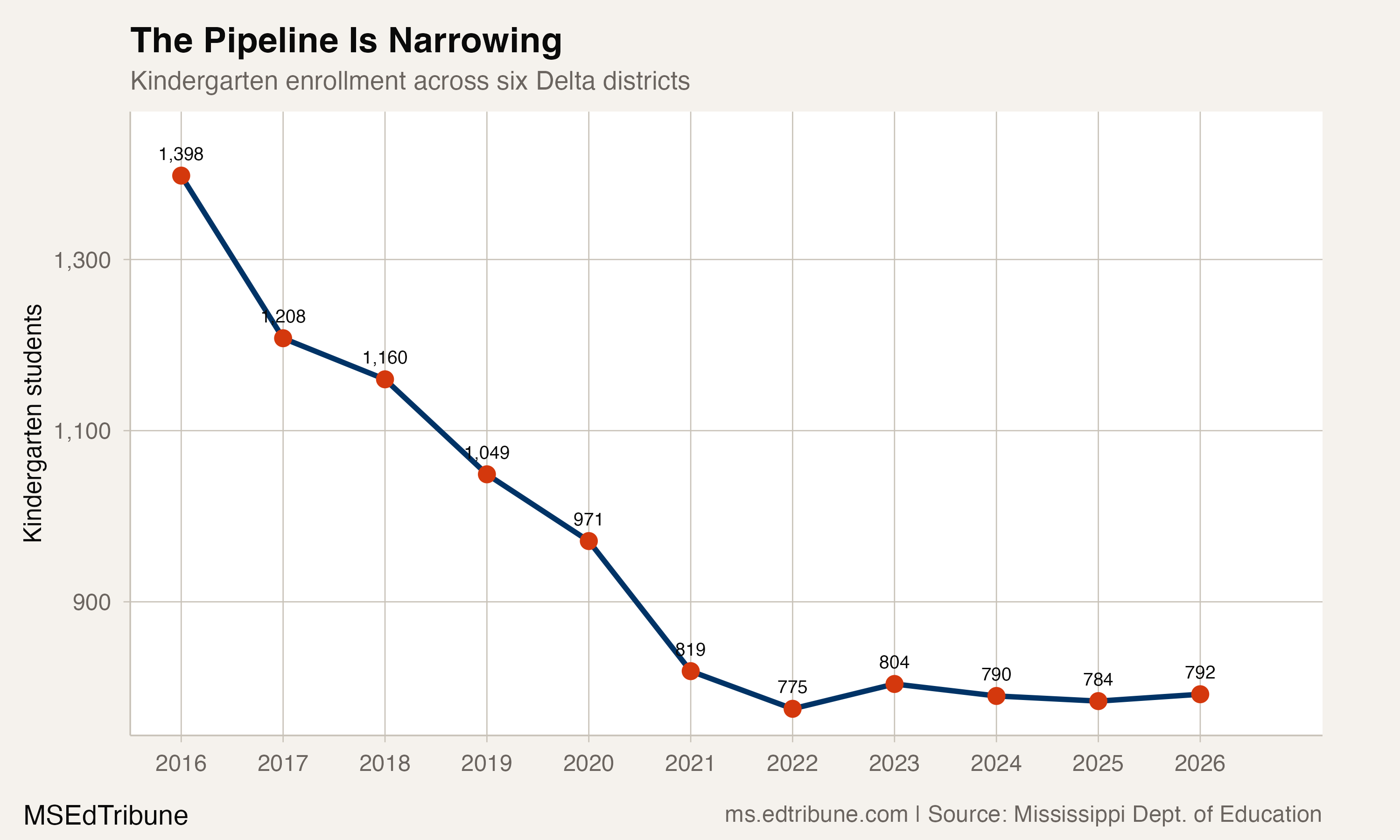
The kindergarten pipeline tells a starker version of the same story. In 2015-16, these six districts enrolled 1,398 kindergartners. By 2021-22, that number had fallen to 775, a drop of 44.6%. It has since stabilized near 790, but at a level that is 43.3% below where it stood a decade ago. Fewer kindergartners in 2025-26 mean fewer fifth-graders in 2031, fewer ninth-graders in 2035. The pipeline does not refill on its own.
Across all grades, the deepest losses since 2016 are in the elementary and middle school years: third grade is down 48.8%, seventh grade down 46.2%, second grade down 44.0%. High school grades have declined less steeply, with ninth grade down 12.3% and twelfth grade down 8.1%. The implication is straightforward: the younger the grade, the deeper the erosion, and the full impact of the pipeline collapse had not reached the upper grades as of 2025-26.
Poverty, population loss, and a staffing crisis
The Mississippi Delta's enrollment decline is not happening in a vacuum. It tracks decades of population loss from one of the poorest regions in the United States. Census data show that Washington County, home to Greenville, had a population of 51,137 in 2010 and has continued to shrink. Sunflower County stood at 29,450. These are small, mostly rural counties where a few hundred departing families can reshape an entire school district.
The most likely driver is sustained out-migration. Young adults leave for jobs in Jackson, Memphis, or further afield, and the school-age population follows. A 2021 Mississippi Today analysis found that counties along the Mississippi River lost significant population between 2010 and 2020, with the statewide Black population declining by 13,940 people over the decade. The Delta, where Black residents have historically made up the vast majority of the population, bore a disproportionate share of that loss.
A compounding factor is the region's chronic teacher shortage. A Hechinger Report investigation found that a Delta district is 114 times more likely to experience teacher shortages than a non-Delta district, and that as many as 70% of classes in some Delta schools are taught by uncertified teachers. Mississippi's average teacher salary ranked last in the nation at the time of the report, and the local salary supplement in East Tallahatchie was $9.72 per year.
"You can get that at Walmart." -- Maurice Smith, superintendent, quoted in The Hechinger Report
That staffing crisis feeds the enrollment spiral: families who can leave for districts with certified teachers do, and the districts they leave behind become harder to staff.
Funding follows students out the door
When enrollment drops by a third, funding follows. The Hechinger Report documented that the Clarksdale Municipal School District lost nearly $16 million due to state budget cuts since 2007, and Jackson Public Schools lost more than $116 million over the same period. Enrollment decline compounds those cuts: fewer students means less per-pupil revenue on top of the already-reduced allocations.
Mississippi replaced its longstanding funding formula, the Mississippi Adequate Education Program, with the new Mississippi Student Funding Formula in 2024, adding roughly $240 million statewide and increasing the weight for low-income students from 5% to 30%. The base per-student allotment is $6,695. For property-poor Delta districts with virtually no local tax base to supplement state dollars, the formula change matters. But per-pupil funding increases cannot compensate for a district that has lost a third of its students.
"The purpose of this is to help the districts that do not have a tax base." -- Rep. Rob Roberson, House Education Chairman, quoted in Magnolia Tribune
A Mississippi First analysis warned that the expiration of federal ESSER pandemic relief funds in September 2024 would force the most precarious districts to cut programs or consolidate schools. These six Delta districts have already gone from 43 schools in 2016 to 36 in 2026. The average Delta school now enrolls 296 students, compared to a statewide average of 497.
The school choice question
The Mississippi Legislature is debating school choice legislation that would allow public dollars to follow students to private schools. For Delta districts, where private school options are limited and the nearest alternative may be an hour's drive, the direct enrollment impact would likely be small. But the fiscal risk is real: even a modest outflow of students from districts already operating on thin margins could force further consolidation.
Rev. Jessie King, superintendent of the Leland School District in the Delta, put it bluntly in The Leland Progress:
"Choice risks creating two educational systems with unlevel playing fields."
King noted that a shift of just five students can tighten budgets significantly in a small rural district, and losing ten typically forces the elimination of a teaching position.
A note on the demographics data
These six districts are overwhelmingly Black. Prior to 2024-25, Black students consistently made up 95% or more of combined enrollment, with white enrollment in the low single digits. In 2024-25, the reported Black share dropped to 81.8% while students classified as multiracial surged from near zero to 1,736 (16.1% of enrollment). In 2025-26, the pattern persisted: 81.7% Black, 15.2% multiracial, 1.2% white. This is almost certainly a reclassification of how students are categorized rather than a demographic shift. Total enrollment barely changed between 2023-24 and 2024-25 (10,931 to 10,771) while the multiracial count jumped and the Black count fell by a nearly identical amount. The underlying population of these districts has not meaningfully changed in racial composition.
Fewer students, fewer options
The kindergarten numbers have stabilized near 790, which is better than continued freefall but still 43.3% below the 2015-16 level. If the pipeline holds at roughly this size, these six districts will graduate their current seniors and replace them with incoming classes that are 35% to 48% smaller than what they had a decade ago. Combined enrollment could fall below 9,000 by 2030.
A region that has lost a third of its students in a decade, that staffs classrooms with uncertified teachers, and that averages fewer than 300 students per school is running out of room to cut. In February 2026, a consolidation bill died in the Mississippi Senate without a vote. The legislature said no. The enrollment data does not care.
Detailed code that reproduces the analysis and figures in this article is available exclusively to EdTribune subscribers.
Discussion
Sign in to join the discussion.
Loading comments...