In this series: Mississippi 2025-26 Enrollment.
Correction (Aug. 20, 2026): This article previously used an older Mississippi enrollment snapshot. The statewide grade counts, K-12 composition shares, high-school totals, retention averages, kindergarten trend, pre-K counts, and one district's share of the statewide kindergarten loss (18% to 19%) have been recomputed from the current Mississippi Department of Education enrollment records. The corrected figures are reflected below.
Most grades in Mississippi lost students over the last decade, but the losses are not evenly distributed. Grades 1 through 3 each lost between 18% and 20% of their enrollment since 2015-16. Twelfth grade, by contrast, gained 664 students, an increase of 2.2%.
That gap is the central fact of Mississippi's enrollment future. The 2020-21 kindergarten class of 30,623 is now in fifth grade, while the 2021-22 class of 33,596 is in fourth grade. The smaller cohort will reach high school around 2030. When it does, the relative stability that 9th through 12th grade enrollment has enjoyed for a decade may end.
The staircase of loss
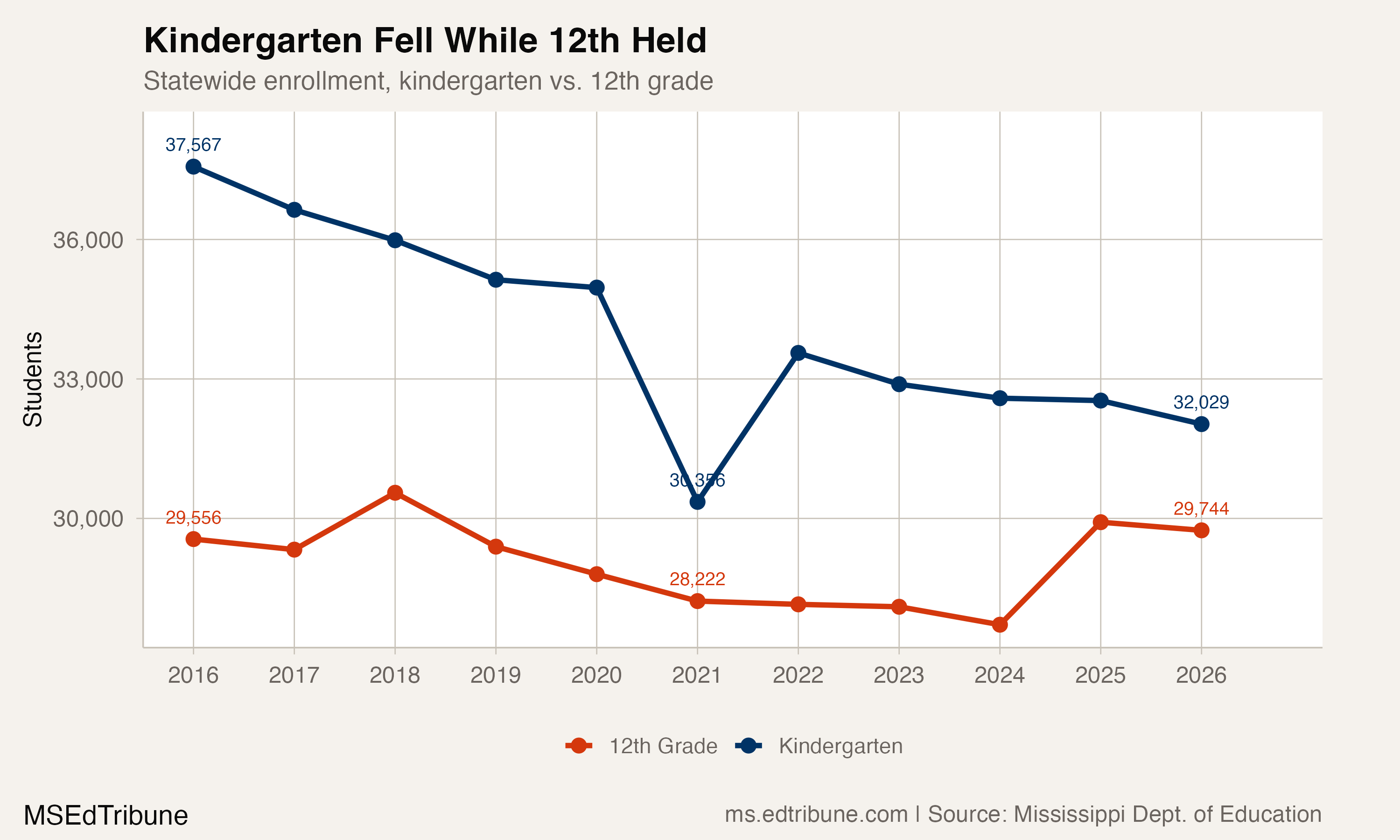
Mississippi enrolled 37,573 kindergartners in 2015-16. By 2025-26, that number fell to 32,225, a decline of 5,348 students, or 14.2%. The drop was not sudden. Kindergarten enrollment fell in eight of the ten years in this window, with the steepest single-year loss coming during COVID, when the kindergarten class plunged 12.4% from 34,968 to 30,623.
But the worst losses are not in kindergarten. They are in the grades just above it.
Third grade lost 8,009 students, or 19.6%, the largest absolute and percentage decline of any grade. Second grade lost 7,744 (-19.2%). First grade lost 7,336 (-18.2%). These grades absorbed the compounding effect: smaller kindergarten classes plus whatever attrition occurs between K and first grade, repeated year after year.
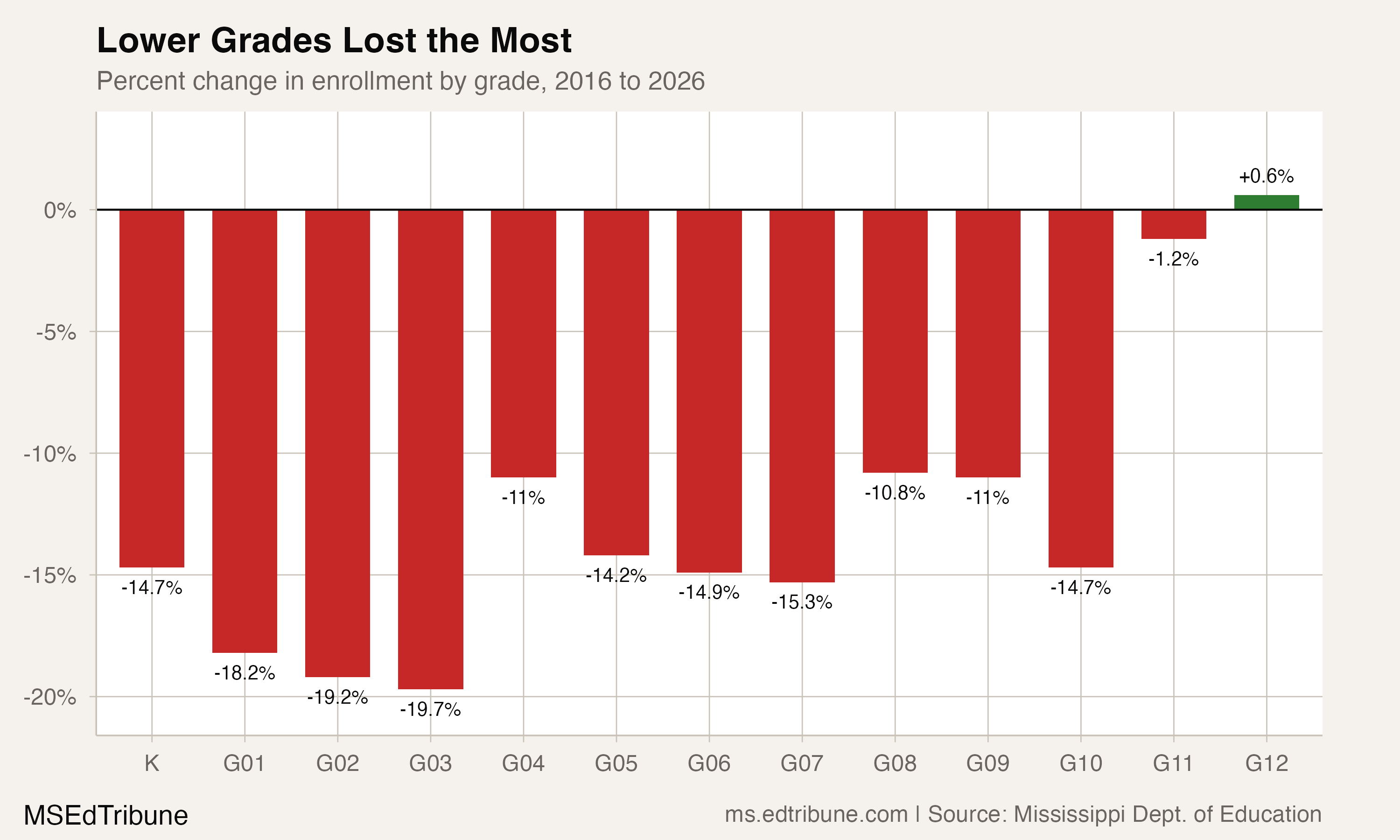
Twelfth grade, meanwhile, enrolled 30,225 students in 2025-26, up from 29,561 a decade earlier. Eleventh grade lost just 1.2%. The high school grades are still processing cohorts that entered kindergarten in the mid-2010s, before the steepest declines.
A temporary shelter
High school's share of K-12 enrollment rose from 28.5% in 2016 to 30.6% in 2026, a two-percentage-point shift that reflects the elementary grades shrinking faster than the upper grades. Elementary grades (K-5) dropped from 48.7% to 46.9% of K-12 enrollment.
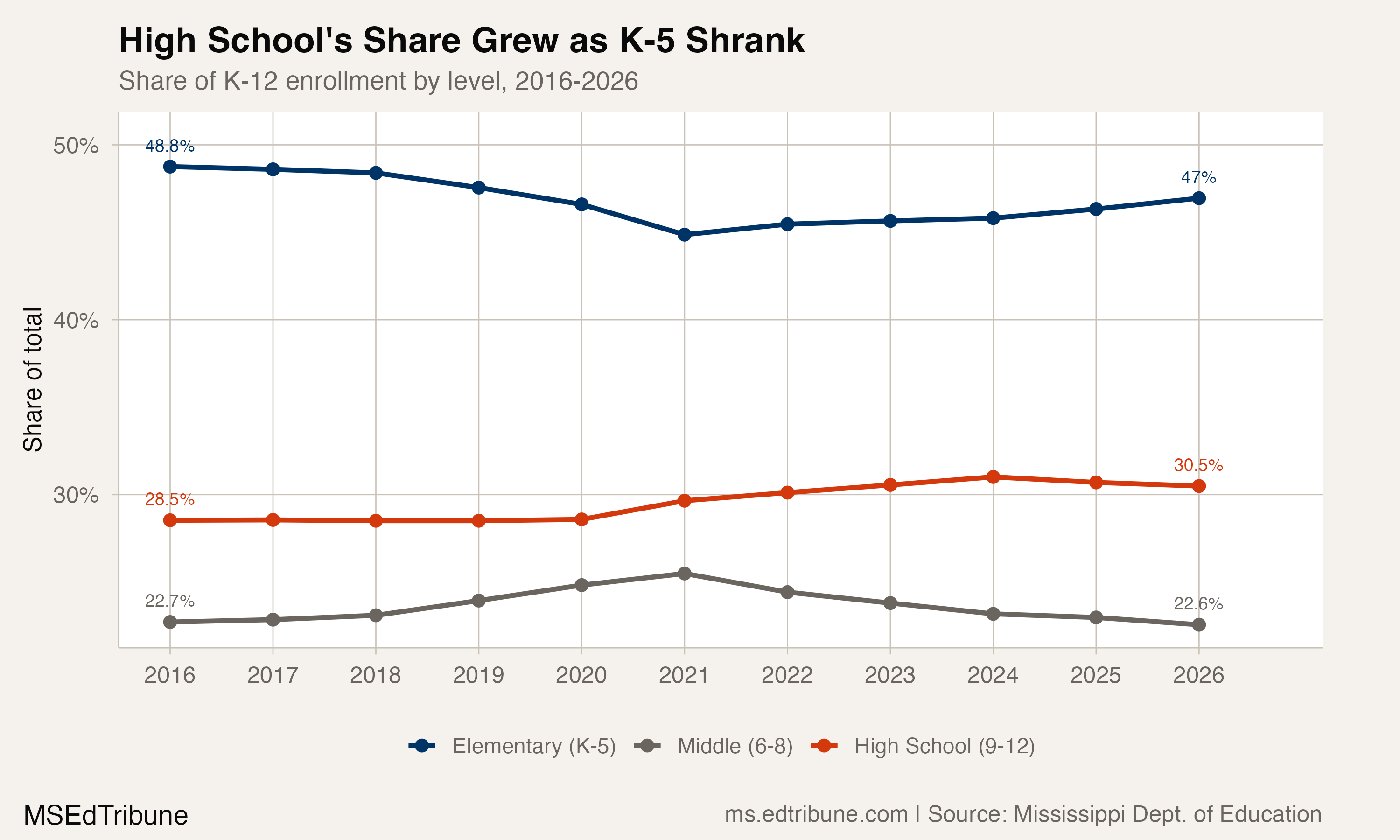
This is not because high schools grew. High school enrollment (grades 9-12) fell from 135,375 to 126,407, a loss of 8,968 students, or 6.6%. But elementary (K-5) lost 37,547 students, or 16.2%, more than four times the high school loss in absolute terms. The share shift is a composition effect: high school held relatively steady while the base underneath it contracted.
The kindergarten class of 2020-21, just 30,623 students, will reach ninth grade around 2029-30. The class of 2025-26, at 32,225, will arrive around 2034-35. The first is close to the current 12th-grade cohort of 30,225, while later classes remain uneven. As these cohorts age up, high school's temporary shelter from the enrollment crisis may end.
The high school leak
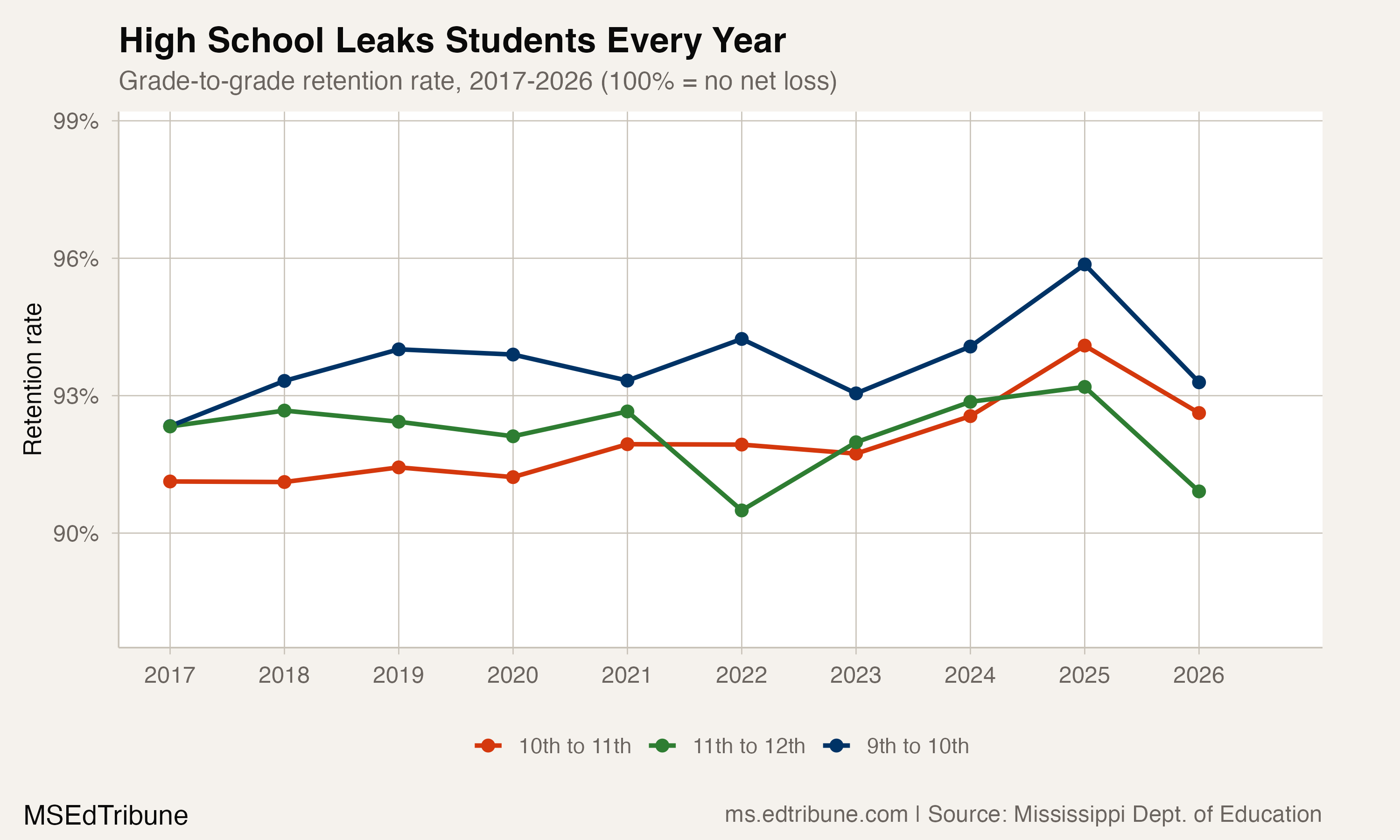
Even as smaller cohorts work their way up through the system, high school itself loses students at every grade transition. Over the last decade, an average of 6.1% of ninth graders did not appear as tenth graders the following year. Another 8.0% disappeared between 10th and 11th grade. And 7.0% of 11th graders did not return as 12th graders.
Compounded across three transitions, roughly one in five ninth graders does not make it to 12th grade in the expected time frame. The cumulative retention rate from ninth to twelfth grade averages 80.3%.
That leakage has improved recently, according to statewide graduation-rate reporting.
But the grade-to-grade retention data captures more than dropouts. It includes students who transfer to private schools, move out of state, are retained in grade, or leave for GED programs. The gap between official graduation measures and the roughly 80% grade-to-grade survival rate reflects the messiness of how students move through the system.
The pipeline problem compounds from both ends. Fewer students are entering at the bottom, and the system continues to lose a significant share at the top. Both forces will compress high school enrollment in the years ahead.
Where kindergartens emptied fastest
Jackson Public↗ET lost 1,004 kindergartners between 2016 and 2026, a 47.4% decline, from 2,117 to 1,113. That single district accounts for 19% of the state's total kindergarten loss.
Jackson's total enrollment fell from 28,019 to 16,968 over the same decade, a 39.4% loss. The kindergarten collapse is both a symptom of and a preview for broader enrollment decline.
"As student enrollment declines, schools face significant financial challenges that may threaten the quality of education they provide." — Mississippi First, "The Devastating Consequences of Declining School Enrollment"
Natchez-Adams↗ET lost exactly half its kindergartners, from 280 to 140. Greenville Public↗ET lost 41.6%, Clarksdale Municipal lost 47.5%. These are Delta and majority-Black districts where the overall population has been shrinking for decades.
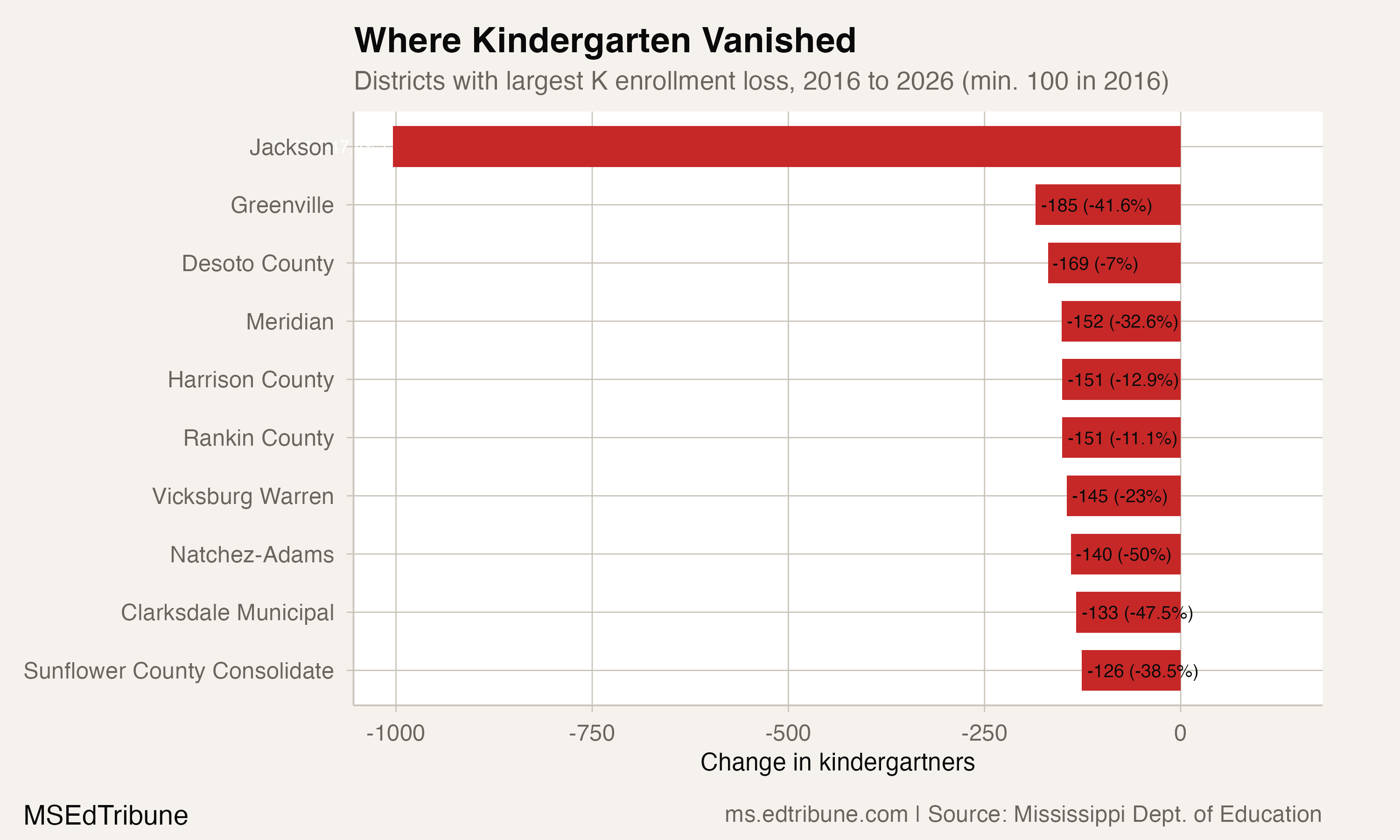
Not every district followed the pattern. Tupelo Public↗ET added 67 kindergartners, growing from 544 to 611 (+12.3%). Starkville-Oktibbeha Consolidated gained 61 (+15.4%). But these are exceptions: university towns and regional employment centers pulling families from surrounding counties.
DeSoto County↗ET, the state's largest suburban district, lost 169 kindergartners (-7.0%), less severe than Jackson but notable for a district that grew rapidly in the 2000s. Even the suburbs are no longer immune.
What is driving the shrinkage
The most direct explanation is that Mississippi has fewer children. The state's child population has declined, according to Mississippi First, due to falling birth rates and out-migration. Out-migration has also contributed, as reported by Magnolia Tribune.
The COVID-19 pandemic accelerated the kindergarten decline but did not cause it. Kindergarten was already falling before 2020. The pandemic years simply dropped the floor further, and the rebound since 2021 has been modest, from 30,623 back to 32,225, still 7.8% below the pre-pandemic figure of 34,968.
Private school enrollment is another factor that public enrollment data cannot capture directly. Mississippi does not publish comprehensive private school counts, so the degree to which families are choosing private over public kindergarten remains unmeasured.
Homeschooling also played a role, particularly during and after the pandemic. Mississippi saw an increase during the pandemic, according to Mississippi First. Some of those families never returned to public schools. The state does not publish annual homeschool enrollment counts, making it impossible to quantify the ongoing effect.
Meanwhile, Mississippi's public pre-K enrollment has expanded substantially. The state operates early-learning collaboratives, as described by Mississippi First.
Public pre-K enrollment in MDE data rose from 4,867 in 2016 to 10,828 in 2026, an increase of 122.5%. But expanding the pipeline's entrance has not prevented the pipeline itself from shrinking.
The fiscal time bomb
Mississippi distributes education funding through the Mississippi Adequate Education Program (MAEP), which is enrollment-based. Fewer students means less money. The formula has not always been fully funded, according to Mississippi First, and the expiration of federal ESSER relief funds removed the last buffer that masked enrollment-driven shortfalls.
For districts that have already lost 40% to 50% of their kindergartners, the fiscal pressure is compounding. Fixed costs, including building maintenance, transportation routes, and administrative staff, do not shrink proportionally with enrollment. A district that loses half its kindergartners does not need half as many kindergarten teachers, but it may need one or two fewer, and the remaining classrooms still need heat and light.
Mississippi is projected to suffer further enrollment declines beyond what has already occurred.
The grade-level data suggests that projection is conservative for elementary schools, which have already crossed the 16% threshold, and optimistic for high schools, which have only begun to feel the squeeze.
Four years to prepare
The kindergarten class of 2020-21, the smallest in this dataset at 30,623, is now in fifth grade. In four years it will enter high school. Whether districts use the intervening time to consolidate schools, restructure staffing, or simply absorb the losses year by year will determine whether the transition is managed or chaotic.
High school enrollment has already declined 6.6% over the decade. The 2020-21 kindergarten cohort that enters ninth grade around 2030 is close in size to the current graduating cohort, but later cohort sizes remain uneven. Every district in Mississippi has roughly four years to decide whether to manage that transition or absorb it.
Detailed code that reproduces the analysis and figures in this article is available exclusively to EdTribune subscribers.
Discussion
Sign in to join the discussion.
Loading comments...