In this series: Mississippi 2025-26 Enrollment.
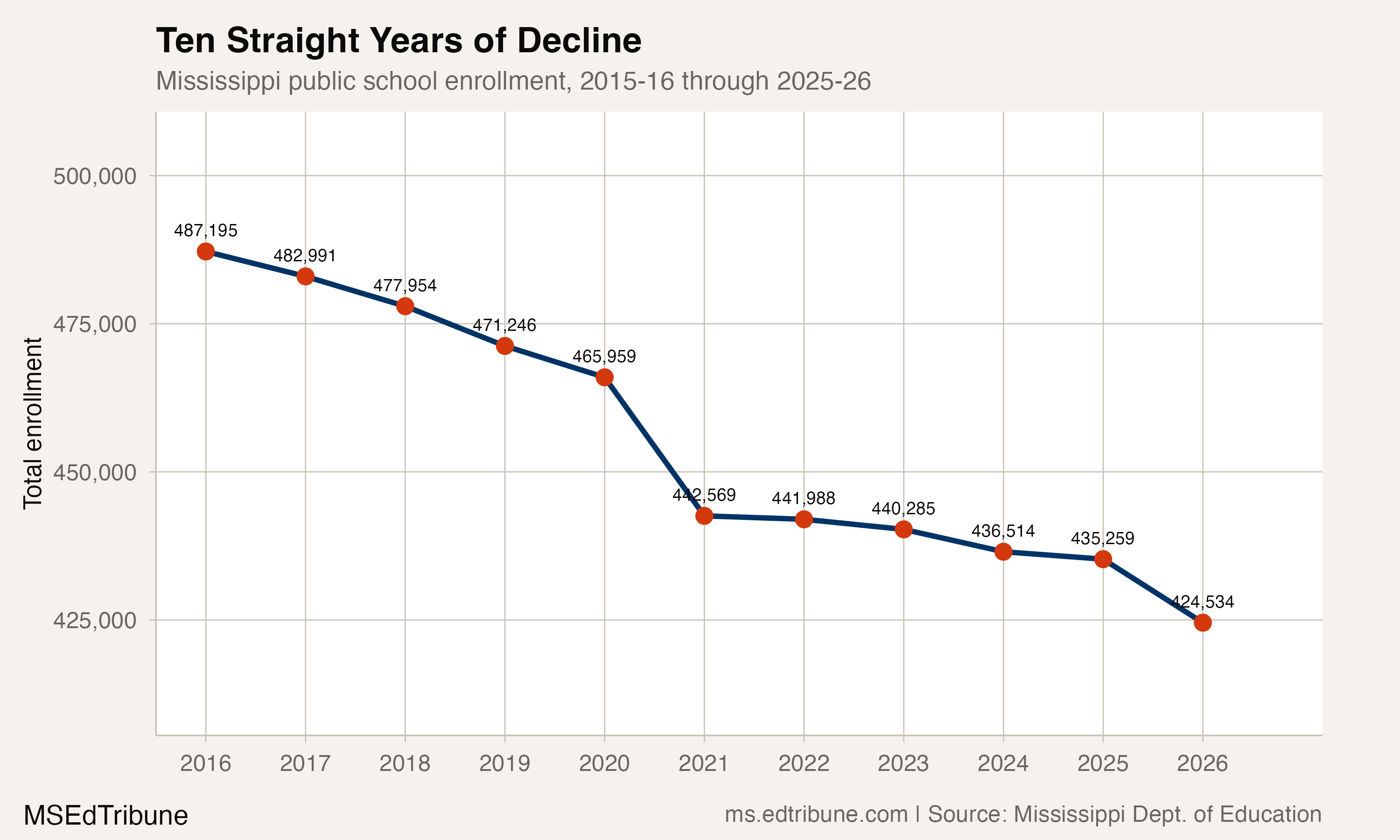
Mississippi's public school system has not grown in a decade. In 2025-26, the state enrolled 424,534 public school students, an all-time low in the data and the tenth consecutive annual decline. Not once since the 2015-16 school year, when enrollment peaked at 487,195, has the number ticked upward. The cumulative loss of 62,661 students, a 12.9% decline, is roughly equivalent to emptying every classroom in the state's 10 largest districts outside Jackson and DeSoto County.
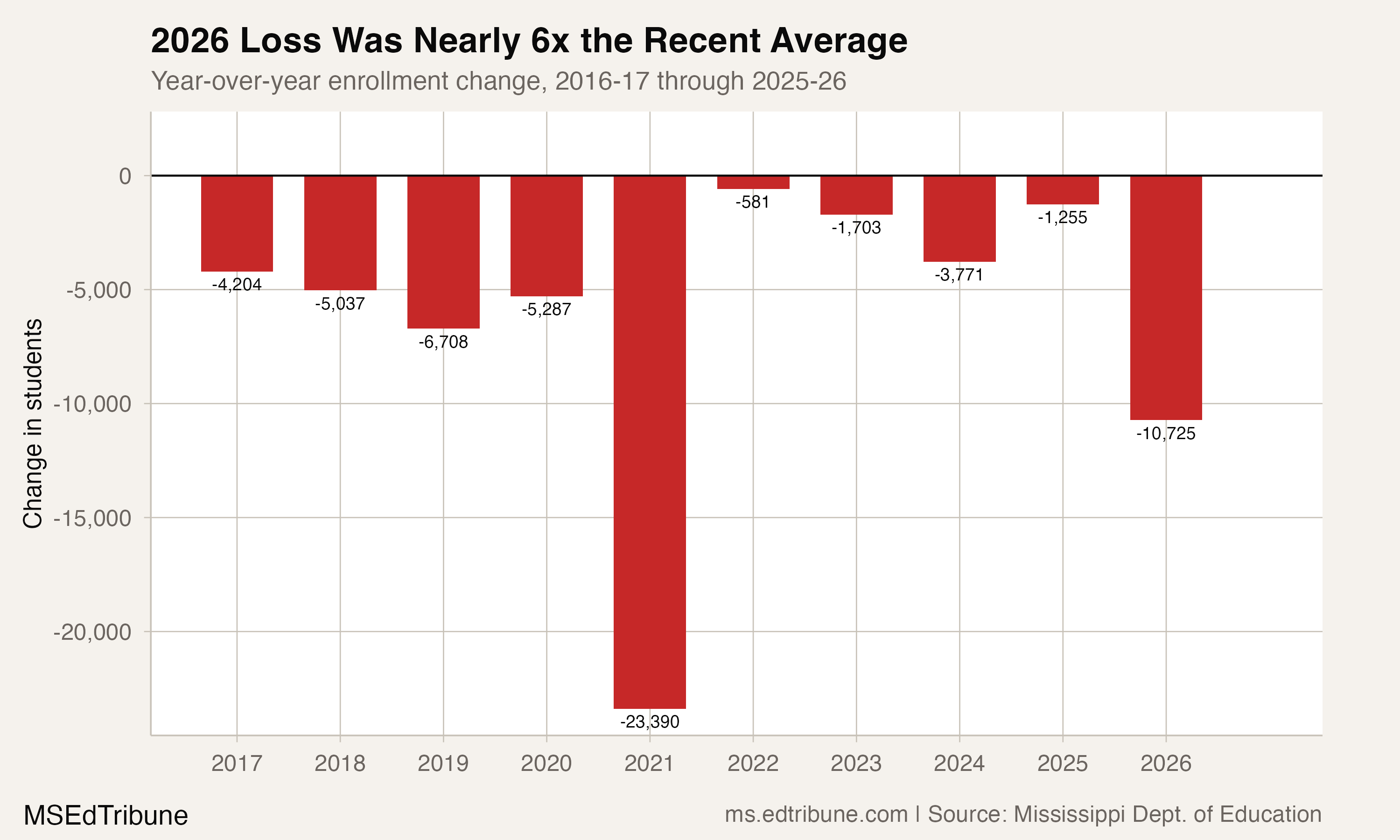
What makes the 2025-26 number particularly striking is the acceleration. From 2021-22 through 2024-25, annual losses averaged 1,828 students, small enough that administrators could describe the trajectory as stabilization. Then 2025-26 arrived: a loss of 10,725 students, 5.9 times the prior four-year average and the second-worst single-year decline on record after the COVID crash of 2020-21.
Four years of losses before the pandemic
The instinct is to blame COVID. But Mississippi was already losing more than 5,000 students a year before the pandemic arrived. Between 2015-16 and 2019-20, the state shed 21,236 students at an average rate of 5,309 per year. The pandemic year of 2020-21 was an accelerant, not a cause: 23,390 students vanished in a single year, a 5.0% drop that dwarfed anything before it.
What followed was an apparent stabilization. The 2021-22 loss was just 581 students, and 2022-23 saw a loss of 1,703. But this was a mirage. Mississippi never recovered a single student lost during COVID. The "stability" of 2022-2025 was simply the decline pausing to catch its breath before 2025-26 delivered another body blow.
The compound annual growth rate across the full decade is -1.37%. At the three-year average pace of the most recent years (5,250 students lost per year from 2023-24 through 2025-26), Mississippi would fall below 400,000 students by 2031.
The state is emptying from the inside out
Of the 140 districts with enrollment data in both 2015-16 and 2025-26, 125 lost students. Only 15 grew. That is an 89% decline rate among districts, a breadth of loss that cannot be explained by any single local factor.
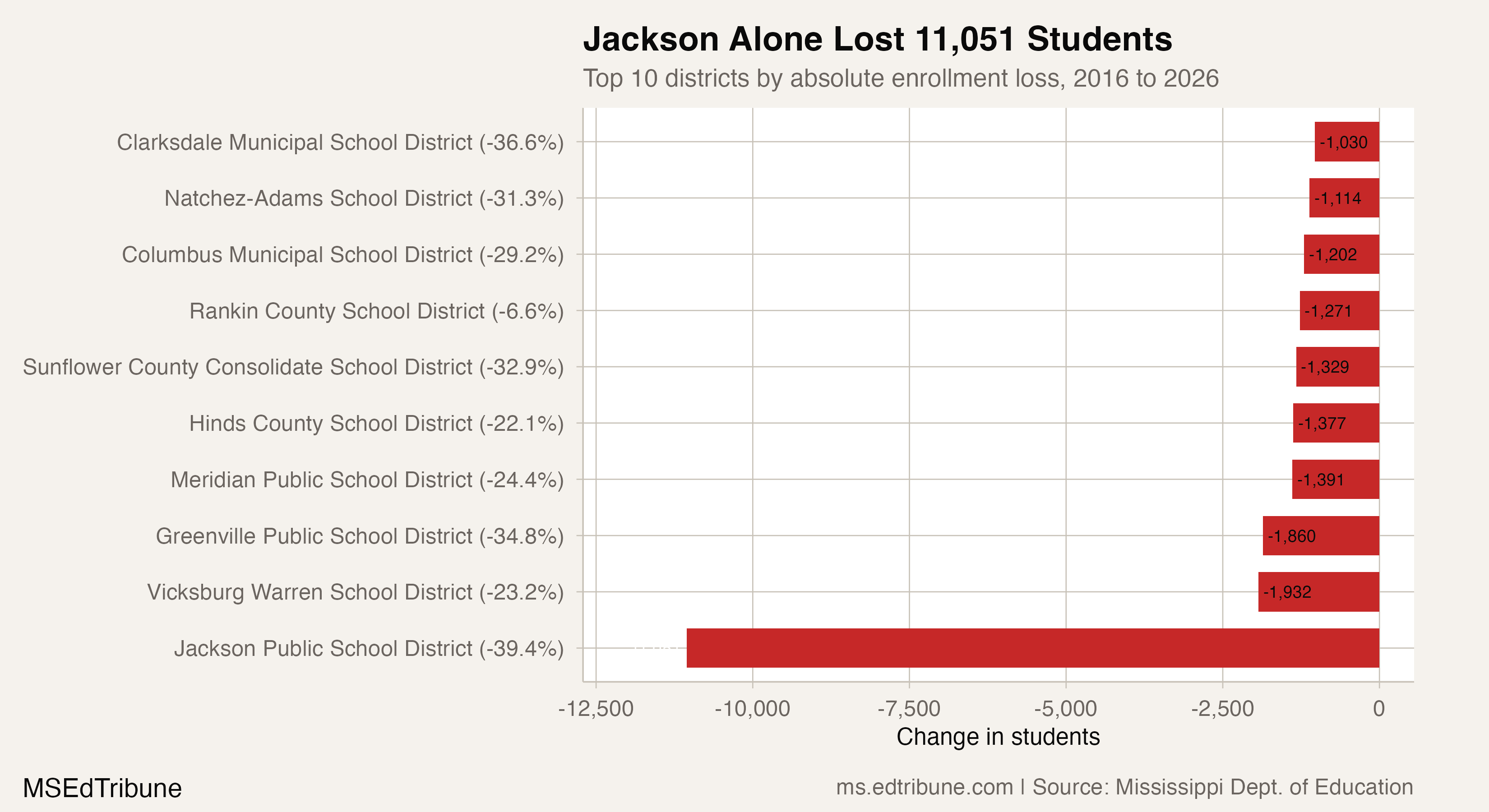
Jackson Public School District accounts for the largest share: 11,051 students lost, a 39.4% decline that dropped enrollment from 28,019 to 16,968. That one district represents 17.6% of the statewide loss. The Jackson school board closed 13 schools in December 2023, citing the enrollment collapse alongside staff shortages and aging infrastructure.
But the concentration is less extreme than it might appear. The top 10 districts by absolute loss account for 36.4% of total district-level losses. The remaining 63.6% is distributed across 113 other declining districts, many of them small, rural, and Delta-based: Greenville (-1,860, or -34.8%), Sunflower County (-1,329, or -32.9%), Clarksdale (-1,030, or -36.6%).
DeSoto County stands as the most visible exception. The suburban Memphis spillover district grew by 1,375 students (+4.1%) over the decade, reaching 34,515. Oxford, home to the University of Mississippi, added 399 students (+9.4%). Together with a handful of small-town districts, they form a thin bright line across a map that is otherwise uniformly red.
Fewer children, fewer Mississippians
The enrollment decline mirrors a broader demographic crisis. Mississippi is one of just three states to lose population over the past decade, and the dynamics driving population loss are the same ones driving enrollment loss: outmigration and declining births.
Between 2010 and 2021, the number of Mississippi residents aged 5 to 19 declined by 6.6% due to families leaving the state and fewer children being born. The state's births fell from roughly 40,000 in 2010 to 35,000 in 2022, while deaths rose to match, according to demographic researchers at the University of Mississippi. For the first time, Mississippi is approaching natural decrease, where deaths outnumber births.
The Jackson metropolitan area is at the center of this exit. Census projections show Jackson experiencing the largest population decline among Mississippi's major cities, with a projected 5% decrease since 2020. Researchers at the University of Mississippi's Center for Population Studies point to a wage gap as a key driver: nearby metros like Nashville offer significantly higher salaries, pulling working-age residents out of the state.
Homeschooling has also pulled students from the public system. During the pandemic, Mississippi saw an 11.6 percentage point increase in the share of homeschooled students between May and September 2020, more than double the national average. While participation has declined from its pandemic peak, it remains elevated above pre-2020 levels.
The kindergarten signal
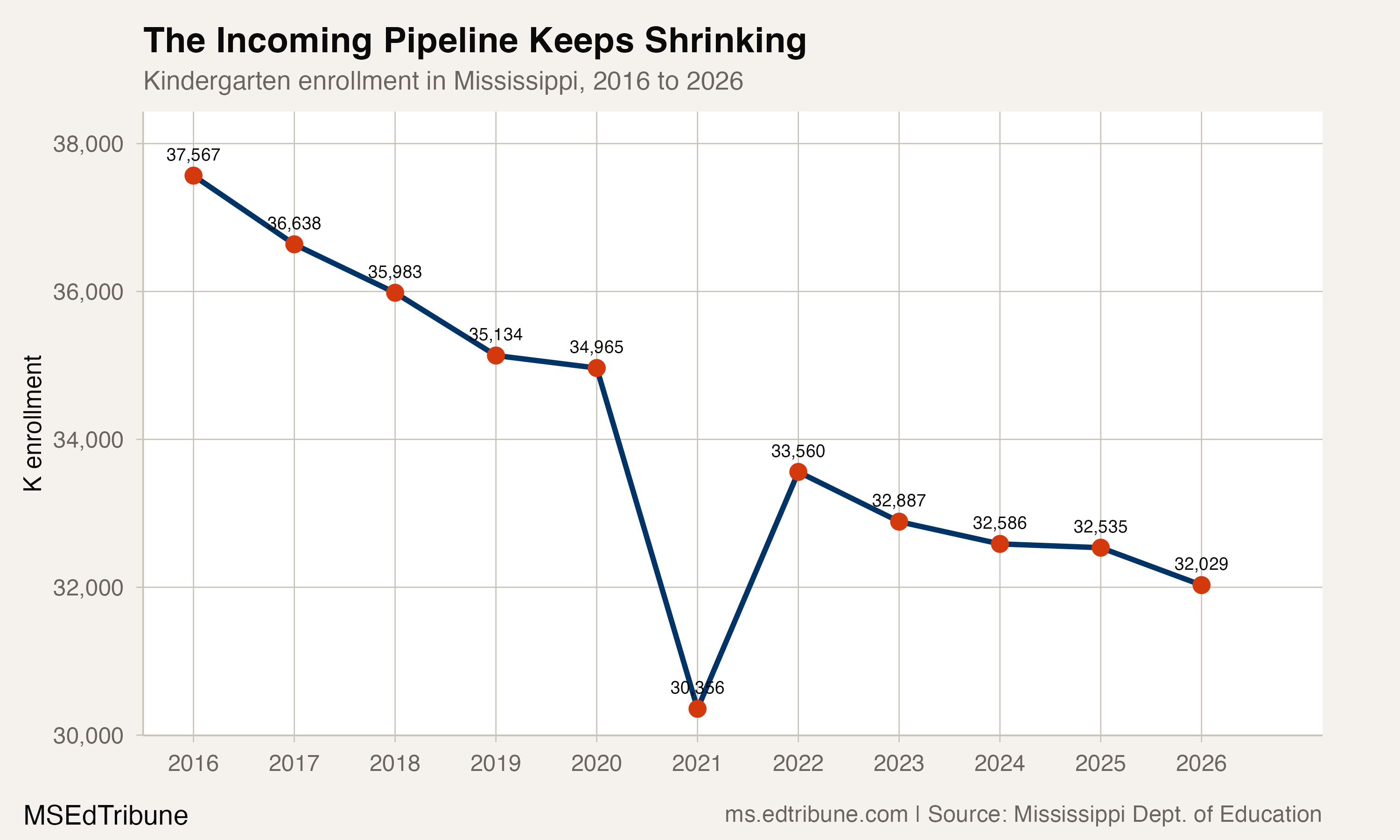
Kindergarten enrollment offers the clearest forward-looking indicator, and in Mississippi it points downward. The state enrolled 32,029 kindergartners in 2025-26, down 14.7% from 37,567 in 2015-16. The COVID-year trough of 30,356 in 2020-21 has only partially recovered; the kindergarten class has hovered between 32,000 and 33,600 for four years.
Every kindergartner who does not show up in 2026 is a first-grader who will not show up in 2027, a fifth-grader missing in 2031, and a twelfth-grader absent in 2038. The pipeline is not just narrower than it was a decade ago. It shows no sign of widening.
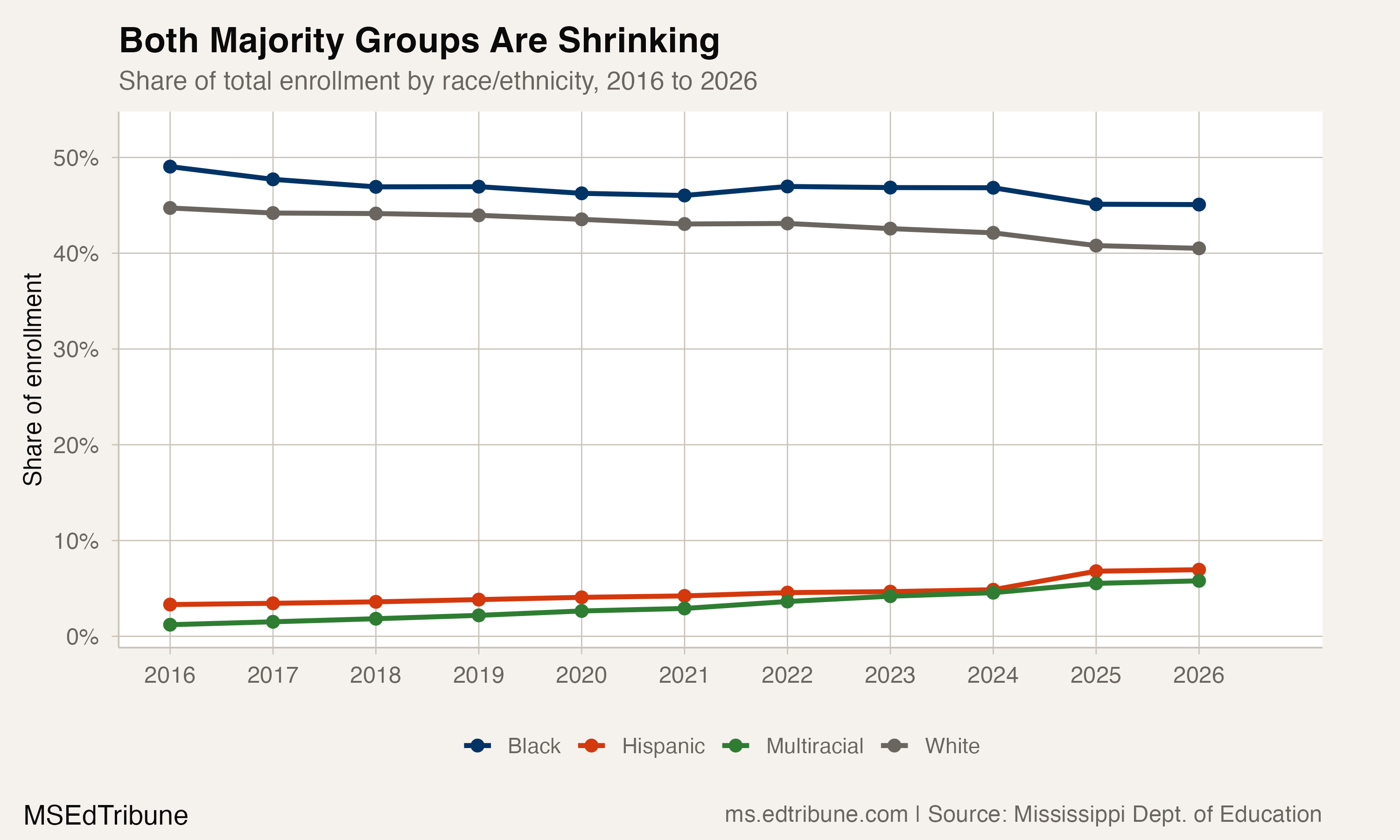
Both majority groups are shrinking
Mississippi's enrollment decline is not concentrated in one racial group. Black enrollment, the state's largest subgroup, fell from 238,935 (49.0% of total) in 2015-16 to 191,377 (45.1%) in 2025-26, a loss of 47,558 students or 19.9%. White enrollment declined from 217,897 (44.7%) to 171,982 (40.5%), a loss of 45,915 students or 21.1%.
The two groups that grew, Hispanic and multiracial, are still small in absolute terms but expanding rapidly. Hispanic enrollment nearly doubled from 16,141 to 29,512. However, this figure requires a significant caveat: Hispanic enrollment jumped 39.4% in a single year between 2023-24 and 2024-25 (from 21,225 to 29,582), a spike almost certainly driven by a classification or reporting change rather than actual arrivals of 8,357 new Hispanic students. Multiracial enrollment quadrupled from 5,884 to 24,573, with similar reclassification dynamics likely at play.
What the data cannot answer
The most important question is why 2025-26 produced a loss nearly six times larger than recent years. The data alone cannot distinguish between several plausible explanations. The September 2024 expiration of ESSER pandemic relief funding, which accounted for nearly 11% of Mississippi's education revenue, may have forced program cuts that pushed families to alternatives. Continued population outmigration is the most direct demographic explanation, consistent with national Census trends showing Mississippi among the nation's fastest-shrinking states.
The state's small but expanding school choice infrastructure is another factor. Mississippi's Education Scholarship Account program for students with special needs served roughly 345 students as of 2025, a number too small to explain the statewide loss. But per-pupil funding of approximately $8,000 follows each student who leaves, and the legislature has moved to clear the program's waitlist and potentially remove enrollment caps.
Ahead: the funding math
Mississippi distributes school funding through the Mississippi Adequate Education Program (MAEP), a formula tied directly to enrollment. Every lost student means lost dollars. Mississippi First, an education policy organization, has warned that the consequences will fall hardest on "property-poor" districts that lack the local tax base to compensate for declining state allocations.
"The consequences of decreasing enrollment on school funding are grave and may have long-lasting effects on the quality of education that Mississippi's schools are able to provide, particularly for the students in the least-advantaged school districts." — Mississippi First
The 2025-26 loss of 10,725 students, at roughly $8,000 per pupil in MAEP funding, represents approximately $86 million in reduced state allocation. That is a one-year figure. The cumulative decade of decline has removed far more from the system, even as fixed costs for buildings, transportation routes, and administrative staff remain.
Every superintendent in the state is already planning for fewer students. The 2027 data will determine how fast. If the three-year trend holds, Mississippi drops below 400,000 public school students before the decade ends. The kindergarten pipeline, the population data, and the 2026 acceleration all point the same direction. Nothing in the numbers suggests a floor.
Detailed code that reproduces the analysis and figures in this article is available exclusively to EdTribune subscribers.
Discussion
Sign in to join the discussion.
Loading comments...