In this series: Mississippi 2025-26 Enrollment.
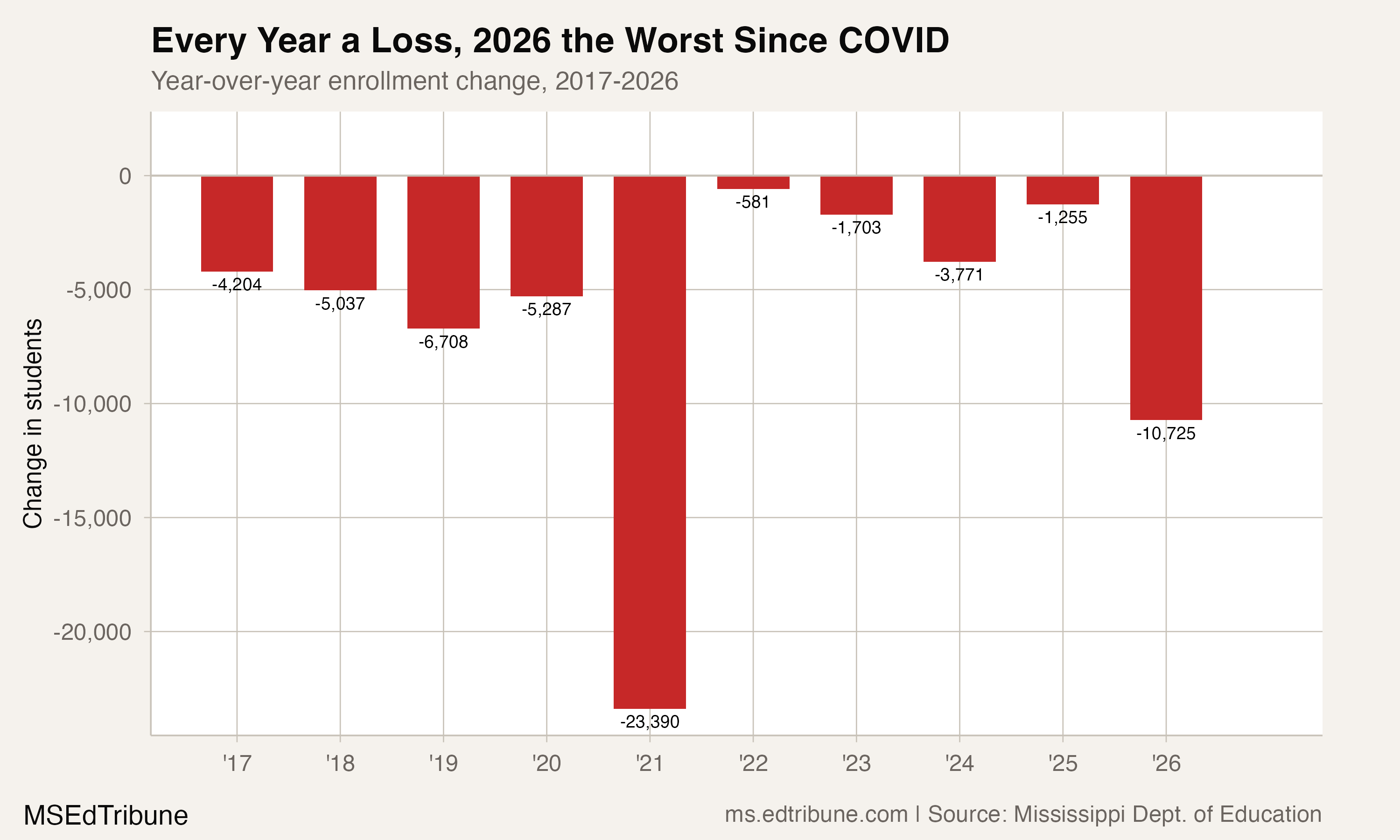
Five years after the pandemic emptied 23,390 seats from Mississippi's public schools in a single year, the state has not recovered a single one of them. It has lost 18,035 more.
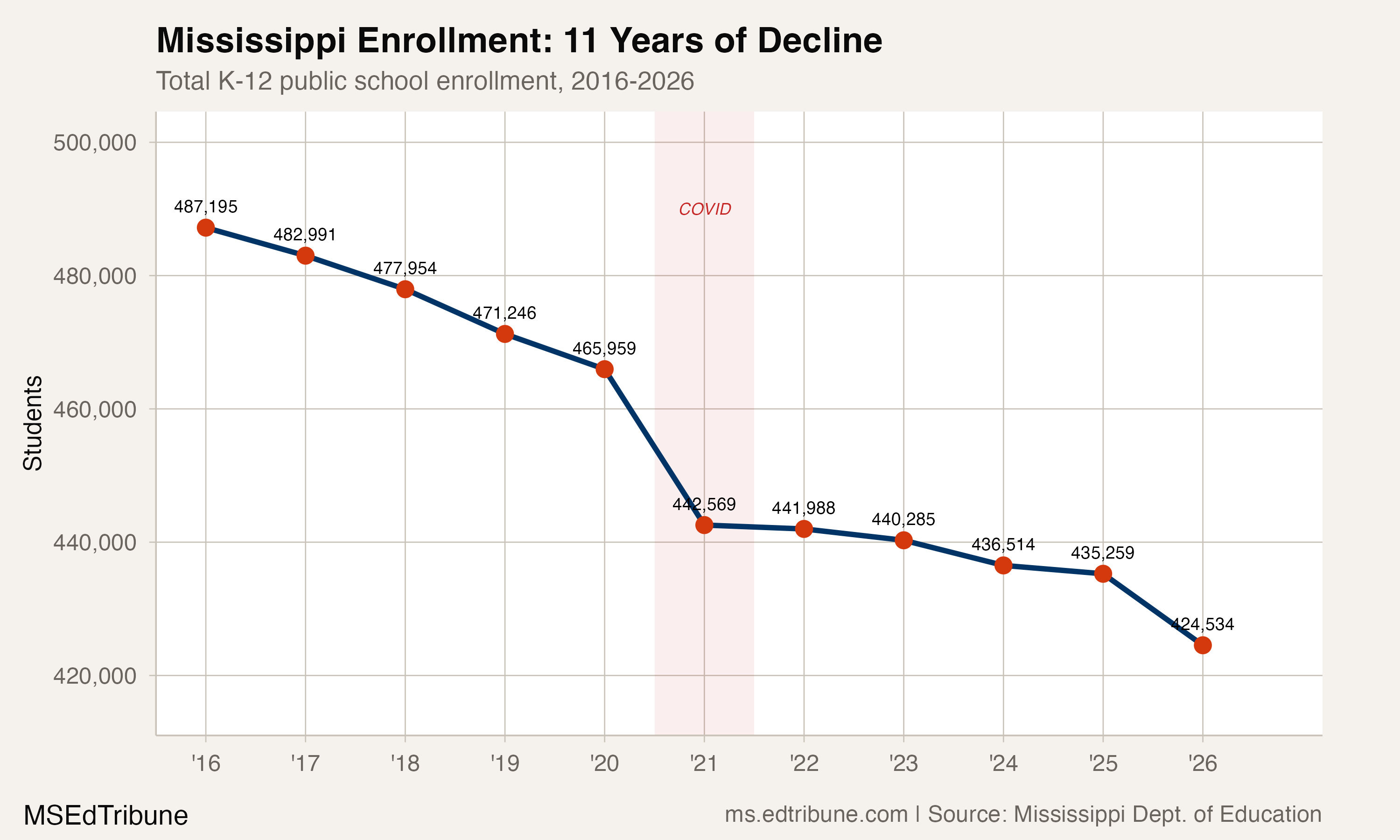
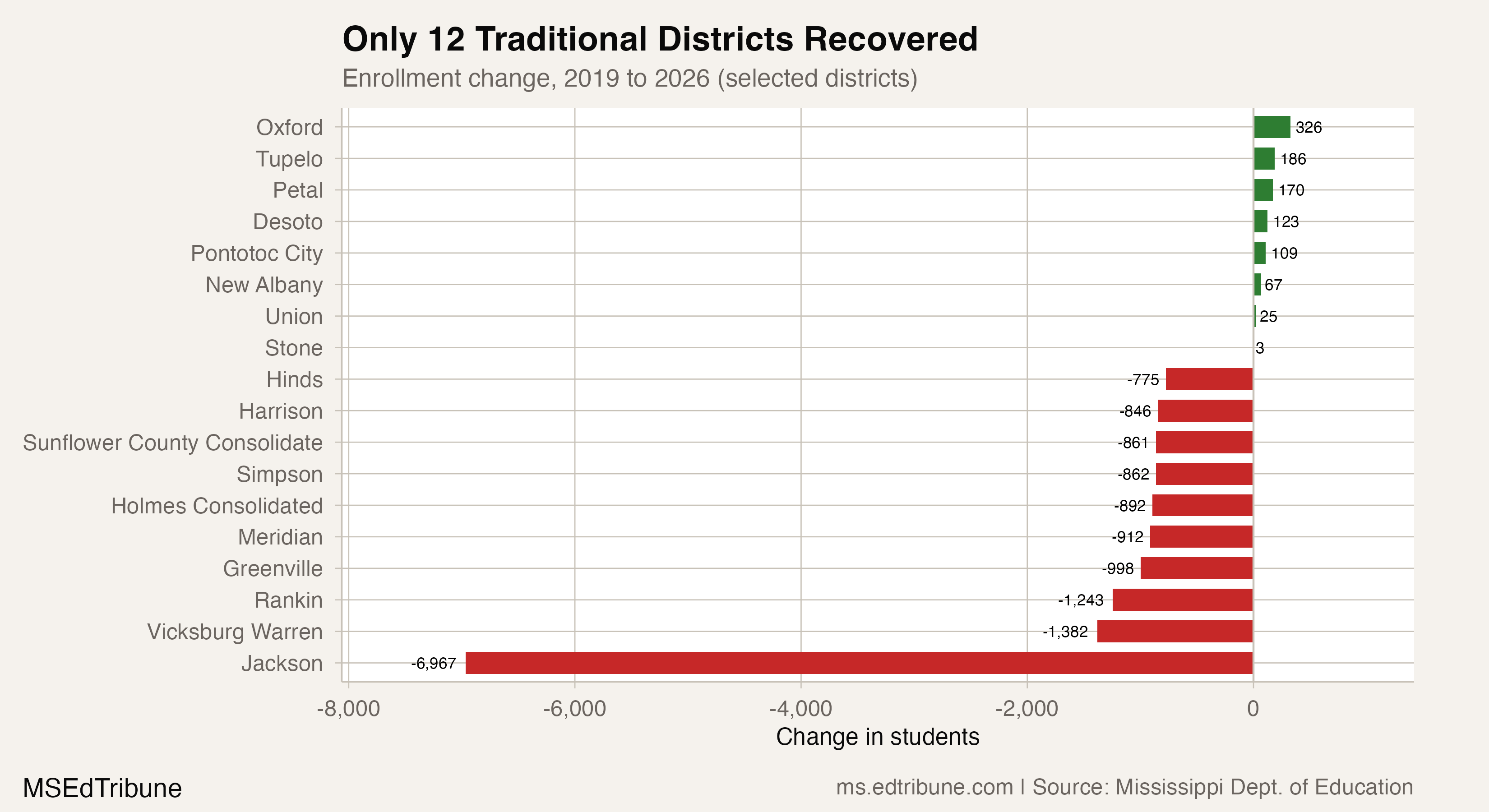
Of 143 traditional school districts with comparable data, 12 enrolled more students in 2025-26 than they did before the pandemic. The other 131 are still below their 2019 levels, and most are falling further behind. The state's 2025-26 enrollment of 424,534 is the lowest in the dataset, down 9.9% from the 471,246 students who attended Mississippi public schools in 2018-19.
A decade with no gains
Mississippi was already losing students before COVID-19 arrived. From 2015-16 through 2018-19, the state shed 4,000 to 6,700 students per year, a steady 1% annual erosion driven by population outmigration and declining birth rates. The pandemic accelerated that trend but did not create it. Every year from 2016 through 2026, enrollment fell. Not once did it rise.
The COVID-19 school year (2020-21) accounted for the sharpest single-year drop: 23,390 students, a 5.0% decline from the prior year. But the years since have been worse in aggregate. Between the 2020-21 trough and 2025-26, Mississippi lost an additional 18,035 students. The cumulative loss since 2018-19 is 46,712, roughly the combined enrollment of the state's three largest districts outside Jackson↗ET.
The 2026 cliff
The 2025-26 school year delivered the largest single-year loss since the pandemic: 10,725 students, a 2.5% drop. Of 152 districts with data for both years, 125 lost students. Only 26 gained. The losses were broadly distributed; the five largest district declines accounted for 28.8% of the total, meaning the hemorrhage was statewide rather than concentrated in a few collapsing systems.
Rankin County↗ET lost 1,083 students in a single year, the largest absolute drop. Jones County lost 726. Jackson lost another 592 on top of years of decline. Even DeSoto County↗ET, one of the few districts that had recovered to pre-COVID levels, shed 493 students, dropping it back toward its 2019 baseline.
Where the 12 survivors are
The 12 traditional districts that have recovered to their 2018-19 enrollment levels share a profile: they are small, suburban, and located along growth corridors in north Mississippi or the Gulf Coast fringe.
DeSoto County, the state's second-largest district at 34,515 students, sits in the Memphis commuter belt. It recovered by 123 students, a margin of 0.4%. Tupelo↗ET gained 186. Oxford↗ET, home to the University of Mississippi, added 326, the largest raw gain among traditional districts, a 7.5% increase. Petal↗ET, a Hattiesburg suburb, grew by 170.
The remaining eight are all under 3,000 students: Union County, Stone County, Pontotoc City, New Albany, Poplarville, Forest Municipal, Senatobia, and Booneville. Stone County's recovery margin is three students.
Four charter-like entities also exceeded their 2019 enrollment, but their combined growth of 1,233 students reflects expansion from small bases, not system-level recovery.
Jackson's accelerating collapse
No district illustrates the post-COVID trajectory more starkly than Jackson Public Schools. The capital city's district enrolled 23,935 students in 2018-19. By 2025-26, that number had fallen to 16,968, a loss of 6,967 students, 29.1% of the district. Jackson alone accounts for 14.9% of the state's total enrollment decline since 2019.
In December 2023, the JPS Board of Trustees voted to close or consolidate 13 schools, with Superintendent Errick Greene warning the district could not survive without drastic action.
The closures reflect a broader reality. Census data show Jackson lost 2.5% of its population between July 2021 and July 2022, making it the fastest-shrinking city in the United States during that period. The metro area's population has declined by more than 22% since 2000. School enrollment is falling faster than the population, suggesting families with children are leaving at higher rates than the general population, or shifting to private schools and homeschooling.
Where the students went
Mississippi does not track individual student transfers, so the destination of 62,661 students lost since 2015-16 cannot be directly observed. Three mechanisms are most likely operating simultaneously.
Population outmigration is the largest structural driver. Mississippi is one of only three states that lost population over the past decade. The state's school-age population (ages 5-19) declined 6.6% between 2010 and 2021, according to Mississippi First, a nonpartisan education policy organization.
Homeschooling surged during the pandemic and has not fully receded. The Mississippi Department of Education reported that homeschool enrollment jumped from roughly 21,000 students in 2018-19 to 25,780 in 2020-21. While numbers have declined from that peak, they remain above pre-pandemic levels.
Private school enrollment and the state's Education Scholarship Account program play a smaller role. Mississippi's ESA program, limited to students with special needs, serves roughly 500 students. It is not large enough to explain meaningful enrollment shifts. But Mississippi's private school sector has historically enrolled a substantial share of students, and any increase in that share compounds the public school losses.
The kindergarten signal
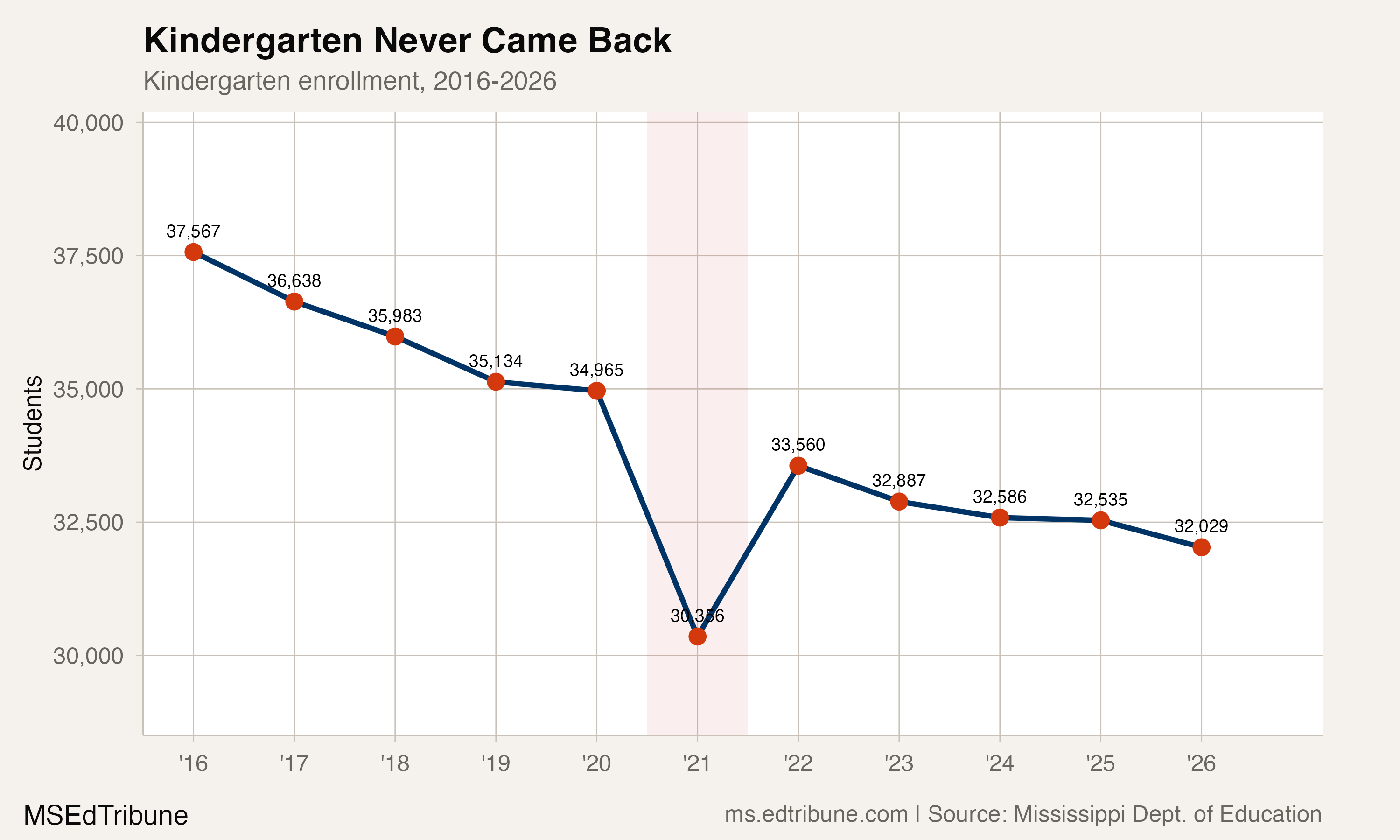
Kindergarten enrollment offers the clearest forward indicator of where the pipeline is headed, and in Mississippi it points downward. The state enrolled 37,567 kindergartners in 2015-16. By 2025-26, that number had fallen to 32,029, a decline of 5,538 students, or 14.7%.
The COVID year cratered kindergarten enrollment to 30,356, a 13.2% drop from the prior year. A partial bounce to 33,560 in 2021-22 suggested some recovery. It did not hold. Kindergarten enrollment has drifted lower in each of the four years since, settling at 32,029 in 2025-26, still 8.4% below the pre-pandemic 2019-20 figure of 34,965.
Smaller kindergarten cohorts flow upward through the grade structure. The 5,538 fewer kindergartners entering the system each year compared to a decade ago will eventually become 5,000+ fewer high school seniors. That pipeline pressure is locked in for the next 12 years.
The fiscal shadow
The enrollment decline has landed in tandem with the expiration of federal pandemic relief funding. Mississippi received $1.4 billion in ESSER III funds, which districts used for facility improvements, learning loss programs, and staffing. As of August 2024, over $422 million remained unspent.
Mississippi First has warned that the fiscal squeeze will fall hardest on property-poor districts that lack the local tax base to offset declining state allocations.
Districts that can supplement state funding with local property tax revenue will manage the transition. Those that cannot face the choice between cutting programs and consolidating schools. The number of critical teacher shortage areas in the state has more than doubled since 2018-19, topping 100 districts.
The trajectory gap
Mississippi's 87 districts at all-time low enrollment, 57.2% of the state's districts, are not outliers. They are the norm. The 10,725-student loss in 2026 landed on top of five years of post-COVID erosion that had already erased any hope of recovery.
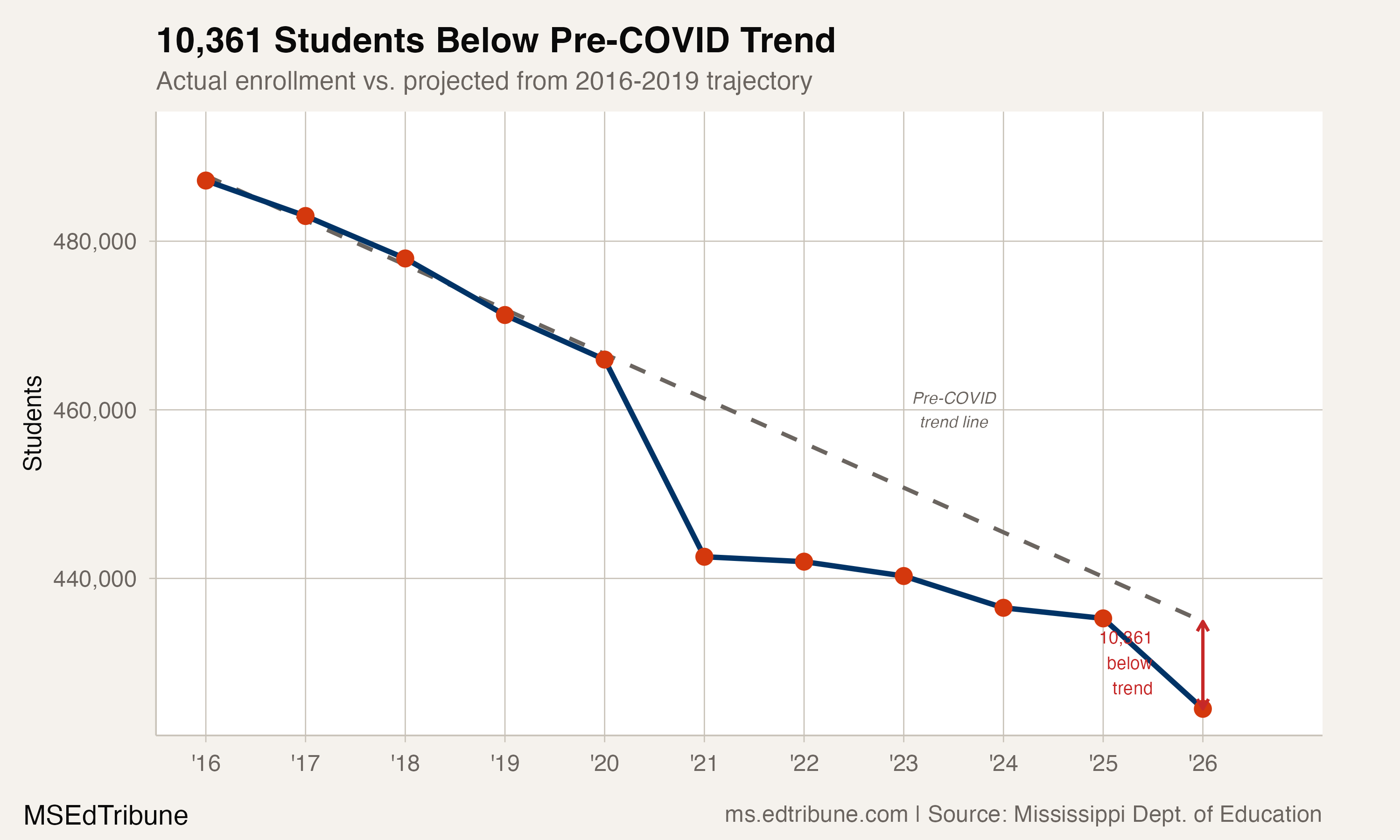
Had the pre-COVID trend (2016-2019) continued without interruption, Mississippi would enroll an estimated 434,895 students today. The actual figure of 424,534 is 10,361 students below that trajectory. COVID did not cause the decline. It deepened a decline that was already underway and removed any prospect of reversal. The state is losing students because it is losing people, and there is no year in the data when that changed.
Detailed code that reproduces the analysis and figures in this article is available exclusively to EdTribune subscribers.
Discussion
Sign in to join the discussion.
Loading comments...