In this series: Mississippi 2025-26 Enrollment.
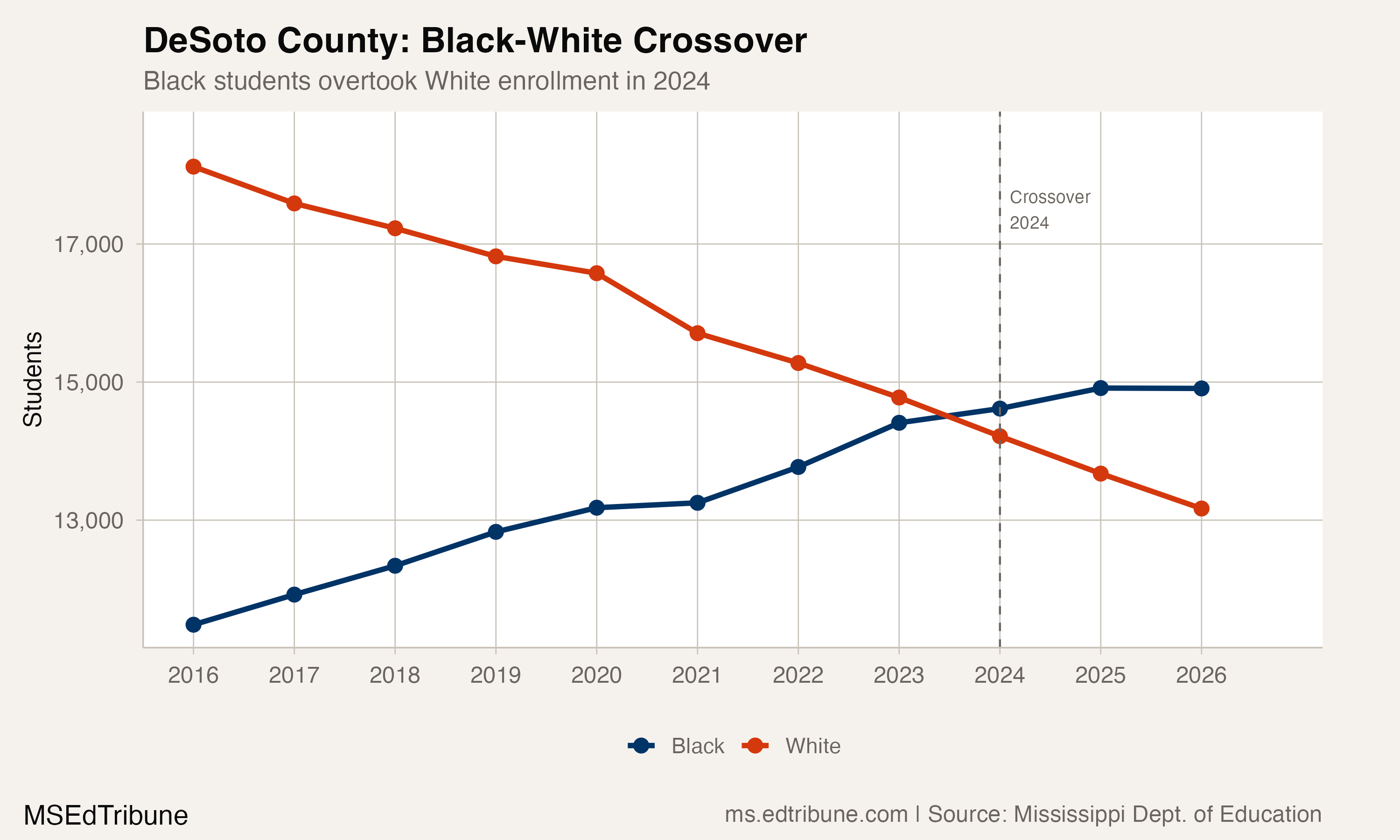
In 2023, DeSoto County School District↗ET had 14,776 White students and 14,410 Black students. The gap was 366. One year later, it flipped: 14,616 Black students, 14,215 White. That 401-student crossover ended a stretch of White-plurality enrollment that had defined Mississippi's largest school district for as long as the data reaches back.
By 2026, the gap widened to 1,740 students. Black enrollment reached 14,908 (43.2% of the district), White enrollment fell to 13,168 (38.2%). The crossover was not sudden. It was the product of a decade-long convergence: White enrollment dropped every year from 2016 to 2026, losing 4,953 students. Black enrollment climbed in nine of those 10 years, adding 3,423.
The district as a whole barely budged. Total enrollment went from 33,140 in 2016 to 34,515 in 2026, a gain of 4.1%. The composition of that enrollment changed entirely.
From two-thirds White to plurality Black
The speed of DeSoto County's demographic shift is remarkable even by the standards of fast-changing Sun Belt suburbs. In the 2006-07 school year, the district was 67.9% White and 26.1% Black. White students outnumbered Black students by more than two to one.
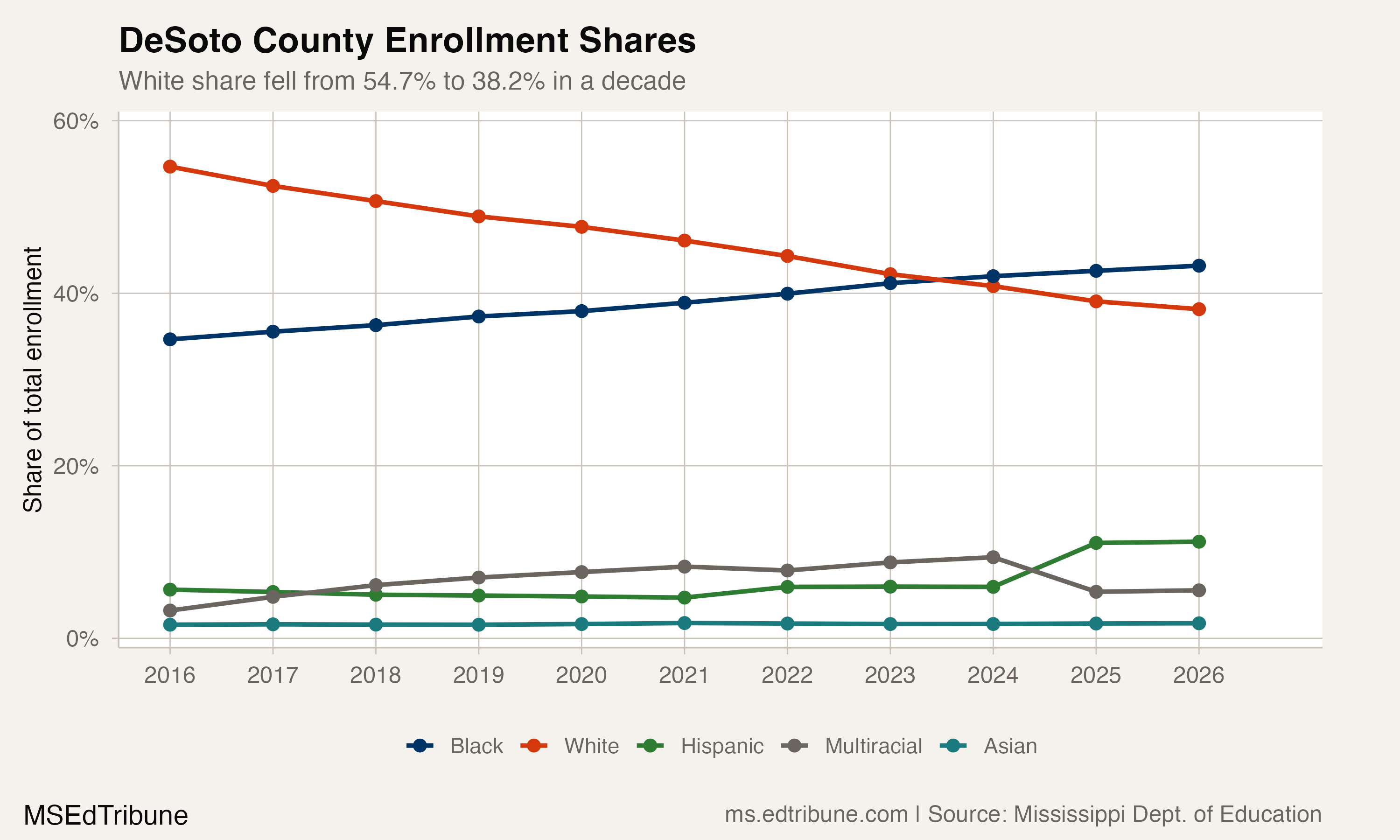
By 2016, White share had already dropped to 54.7%. It crossed below 50% in the 2018-19 school year (48.9%). The decline accelerated after COVID: White enrollment fell by 500 or more students in four of the last five years, including a loss of 869 in 2021 alone, the pandemic year.
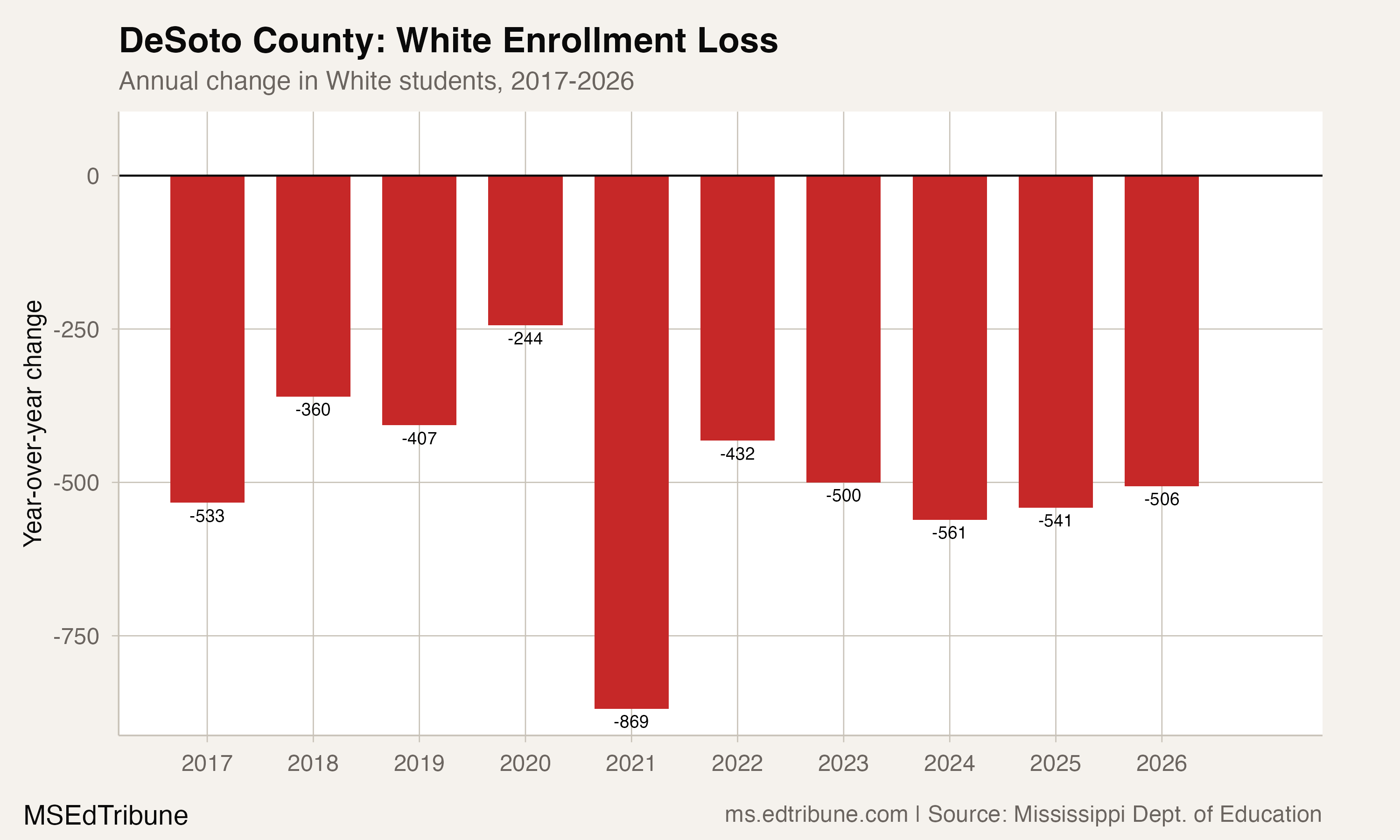
The annual losses amount to roughly 495 White students per year across the decade. No single year showed a gain. DeSoto County lost more White students in absolute terms than any other district in Mississippi between 2016 and 2026 -- more than Rankin County (-3,013), Harrison County (-1,917), or Madison County (-1,304).
Memphis and the interstate migration pattern
DeSoto County sits directly south of Memphis, Tennessee, separated by the state line and connected by Interstate 55. The county's population exploded from 108,000 in 2000 to 185,314 in 2020, a growth rate that made it one of the 40 fastest-growing counties in the United States. It continued growing to an estimated 193,247 by 2023.
The primary mechanism is suburban migration from Memphis. Black middle-class families have been part of this movement for decades. As one Memphis infrastructure official described the broader pattern: infrastructure investments "widened all of the roads on the edge of the city to 7 lanes and extended sewers to allow middle class residents (White and Black) to flee the city" (Smart City Memphis, 2024).
The Christian Science Monitor documented this dynamic in 2023, reporting on Black families who moved to suburban neighborhoods seeking "better schools and an active retail economy."
What makes DeSoto County distinctive is the gap between its school demographics and its census demographics. The county's overall population is roughly 56% White and 33% Black, but its public schools are now 38.2% White and 43.2% Black. That 18-percentage-point gap between the county's White population share and the White school enrollment share points to a second factor beyond migration: White families in the county are disproportionately choosing private schools, homeschooling, or not having school-age children. The enrollment data cannot distinguish which of these factors dominates, but the gap is large enough to be structurally important.
A suburban outlier
DeSoto County's demographic profile is unusual among Mississippi's large suburban districts. Rankin County, south of Jackson, enrolls 60.4% White students. Lamar County, outside Hattiesburg, is 56.9% White. Even Madison County, which has experienced its own diversification near Jackson, still enrolls 43.4% White and 41.2% Black. DeSoto is the only large suburban district where Black students hold a clear plurality.
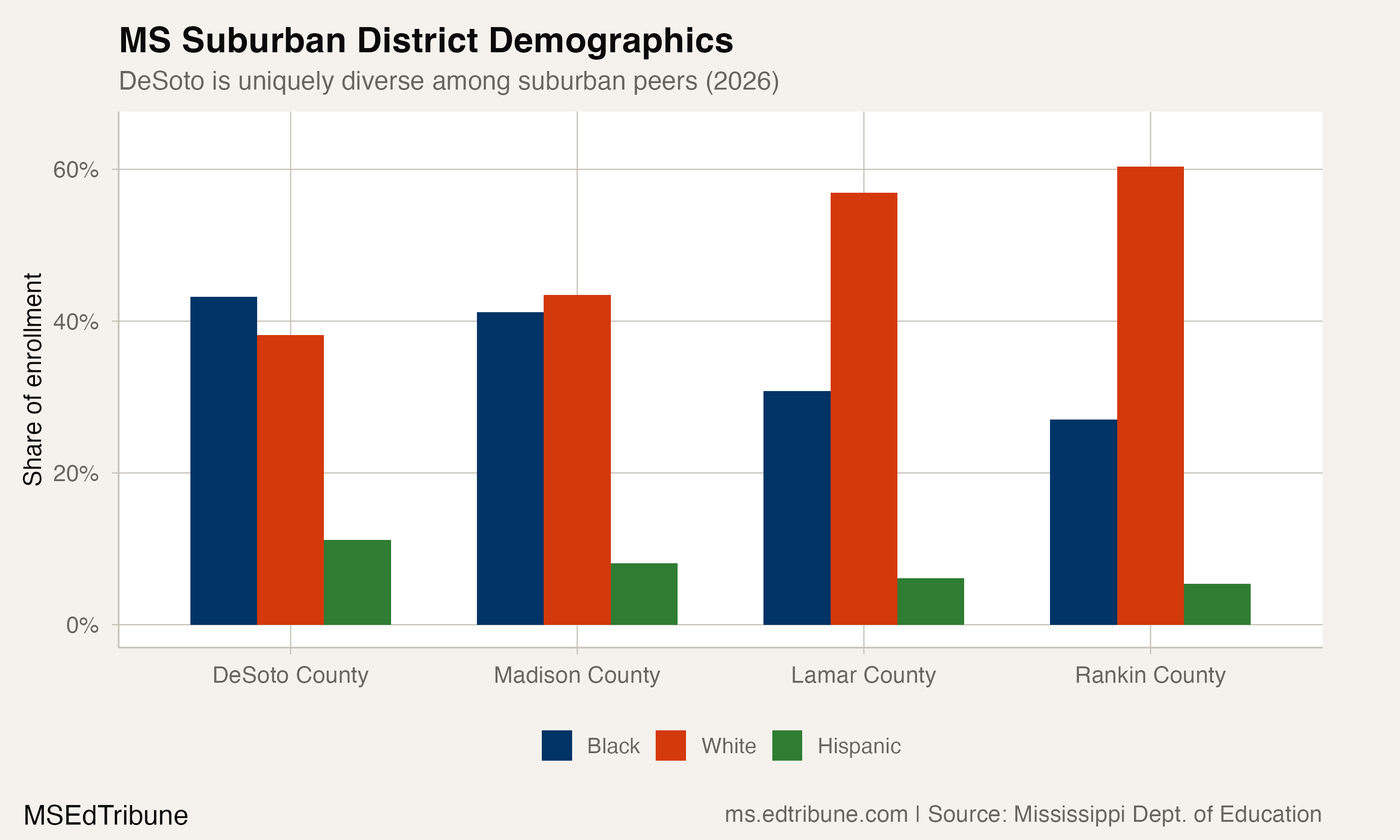
The difference is geography. DeSoto County is part of the Memphis metropolitan area. Rankin, Madison, and Lamar are satellites of smaller Mississippi cities. Memphis, with a metro population exceeding one million, generates suburban migration at a different scale, and the racial composition of that migration reflects Memphis itself, which is roughly 63% Black.
The Hispanic question mark
Hispanic enrollment in DeSoto County tells two different stories depending on the time window. From 2016 to 2024, it was essentially flat, hovering between 1,607 and 2,095 (roughly 5% to 6% of enrollment). Then, between 2024 and 2025, Hispanic enrollment jumped from 2,076 to 3,870, an 86.4% increase in a single year.
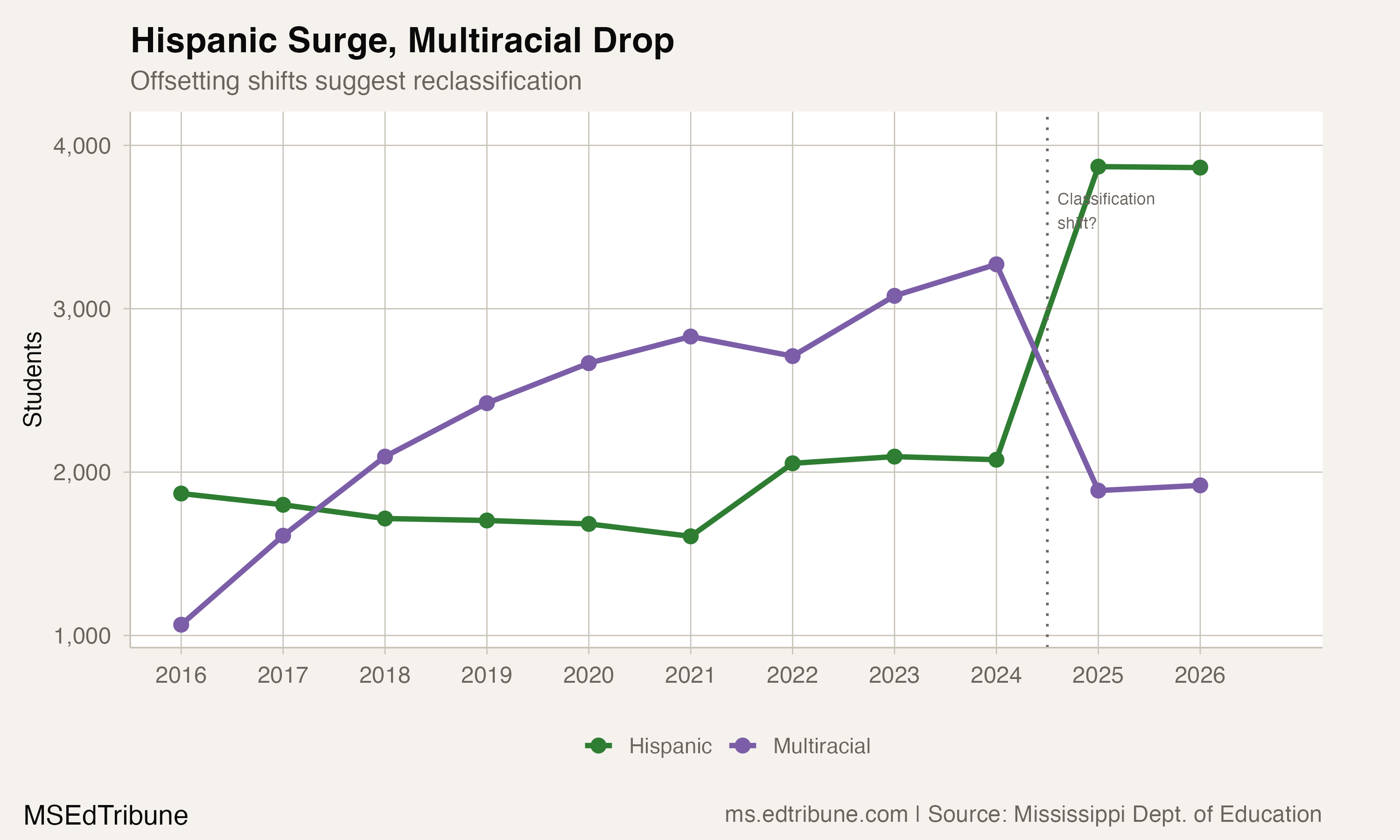
That surge did not happen in isolation. In the same year, multiracial enrollment dropped from 3,272 to 1,887, a loss of 1,385 students (42.3%). The combined Hispanic-plus-multiracial count rose by only 409, from 5,348 to 5,757. The pattern is consistent with a reclassification of students who had previously been reported as multiracial now being counted as Hispanic, not with a wave of new arrivals. No public reporting from the Mississippi Department of Education addresses this shift directly, but the offsetting magnitude is difficult to explain any other way.
This matters because the "true" Hispanic share of DeSoto County's enrollment depends on which year's classification rules you trust. Under the pre-2025 framework, Hispanic enrollment was around 6%. Under the current framework, it is 11.2%. Both numbers describe the same students. The Black-White crossover, by contrast, is unaffected by this reclassification: neither group's count shows the kind of sudden discontinuity that would signal a reporting change.
What the kindergarten numbers suggest
DeSoto County enrolled 2,487 kindergartners in 2020. By 2026, that number had fallen to 2,246, a 9.7% decline. Kindergarten is the closest proxy for incoming demand, and a sustained drop means the district's total enrollment is likely to face downward pressure in coming years regardless of racial composition.
The district's total enrollment peaked at 35,008 in 2025 and dipped to 34,515 in 2026, a loss of 493 students. If kindergarten cohort sizes continue to shrink, DeSoto County's long stretch of stability near 34,000 to 35,000 students may not hold.
DeSoto County built its staffing, facilities, and budgets around being Mississippi's largest district. It will remain diverse — that ship has sailed. Whether it will remain large is a different bet entirely.
Detailed code that reproduces the analysis and figures in this article is available exclusively to EdTribune subscribers.
Discussion
Sign in to join the discussion.
Loading comments...