In this series: Mississippi 2025-26 Enrollment.
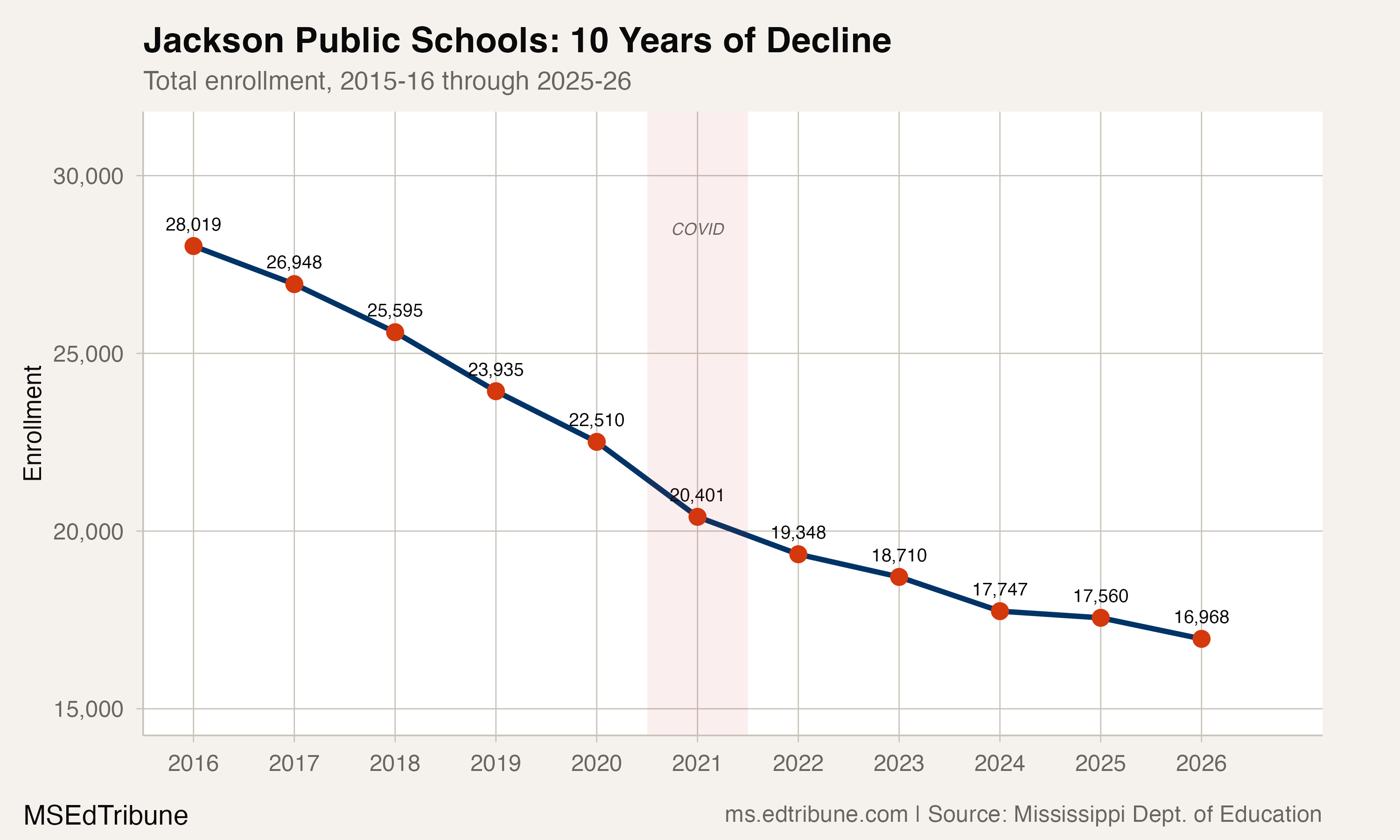
In 2015-16, Jackson Public Schools↗ET enrolled 28,019 students, making it the second-largest district in Mississippi. A decade later, that number is 16,968. The district has lost 11,051 students, a 39.4% decline, and it has not gained enrollment in a single year since at least 2016.
No other large district in the state comes close. Greenville lost 34.8% over the same period. Meridian lost 24.4%. The statewide average was 12.9%. Jackson alone accounts for 17.6% of Mississippi's total enrollment loss, one district out of 152 absorbing nearly a fifth of the damage.
A decline that predates the pandemic
The instinct is to blame COVID. The pandemic year did produce Jackson's worst single-year loss: 2,109 students vanished between 2019-20 and 2020-21, a 9.4% drop. But the four years before COVID were already punishing. From 2016 to 2020, Jackson lost 5,509 students at an average of 1,377 per year, rates that would have been considered a crisis in any other era.
The COVID year accelerated a trajectory that was already steep. And the years since have not reversed it. Post-pandemic, Jackson has lost another 3,433 students, averaging 687 per year. The pace has slowed, but the direction has not changed.
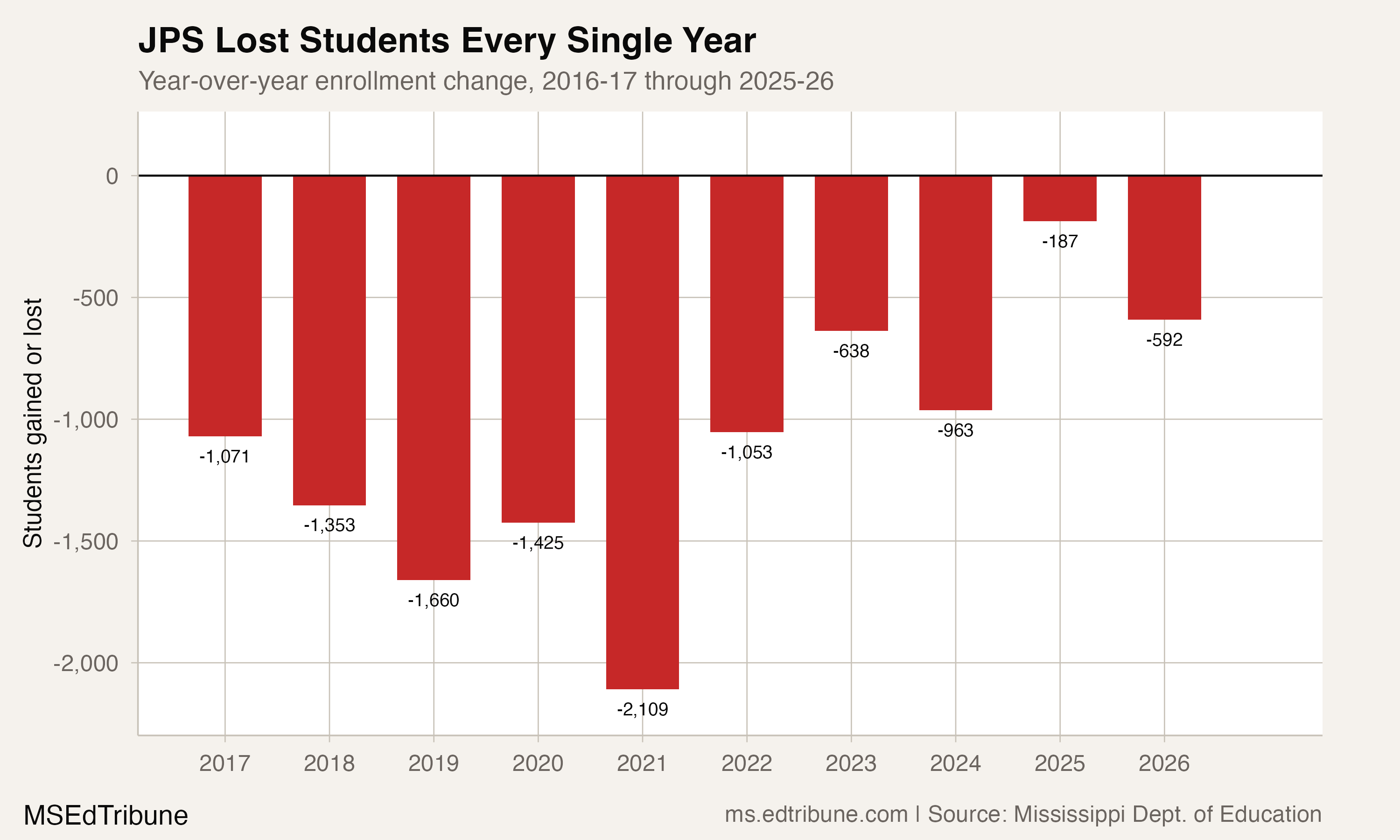
The worst year before COVID was 2018-19, when Jackson shed 1,660 students, a 6.5% decline with no pandemic to blame. That loss alone was larger than the entire enrollment of dozens of Mississippi districts.
Losing rank, losing buildings
Jackson dropped from the state's second-largest district to third in 2022-23, when Rankin County's 18,720 students surpassed Jackson's 18,710. In 2025-26, Rankin holds 17,963 students to Jackson's 16,968. DeSoto County, at 34,515, now enrolls more than twice as many students.
The physical footprint has contracted to match. In 2015-16, Jackson operated 58 schools. By 2023-24, that number had drifted down to 46. Then came the consolidation plan.
In December 2023, Superintendent Errick Greene proposed closing 16 schools, later amended to 13 after community pushback. The board approved the plan, and 11 schools shut their doors at the end of the 2023-24 school year, with four more consolidating in 2025.
"If we do not take drastic action right now, we could, in effect, create a situation where our system cannot survive because we didn't take the measures to stop the bleeding." -- Superintendent Errick Greene, The 74
The closures included Wingfield High School, the only high school on the list. Wingfield held its final graduation ceremony at the Mississippi Coliseum on May 31, 2024.
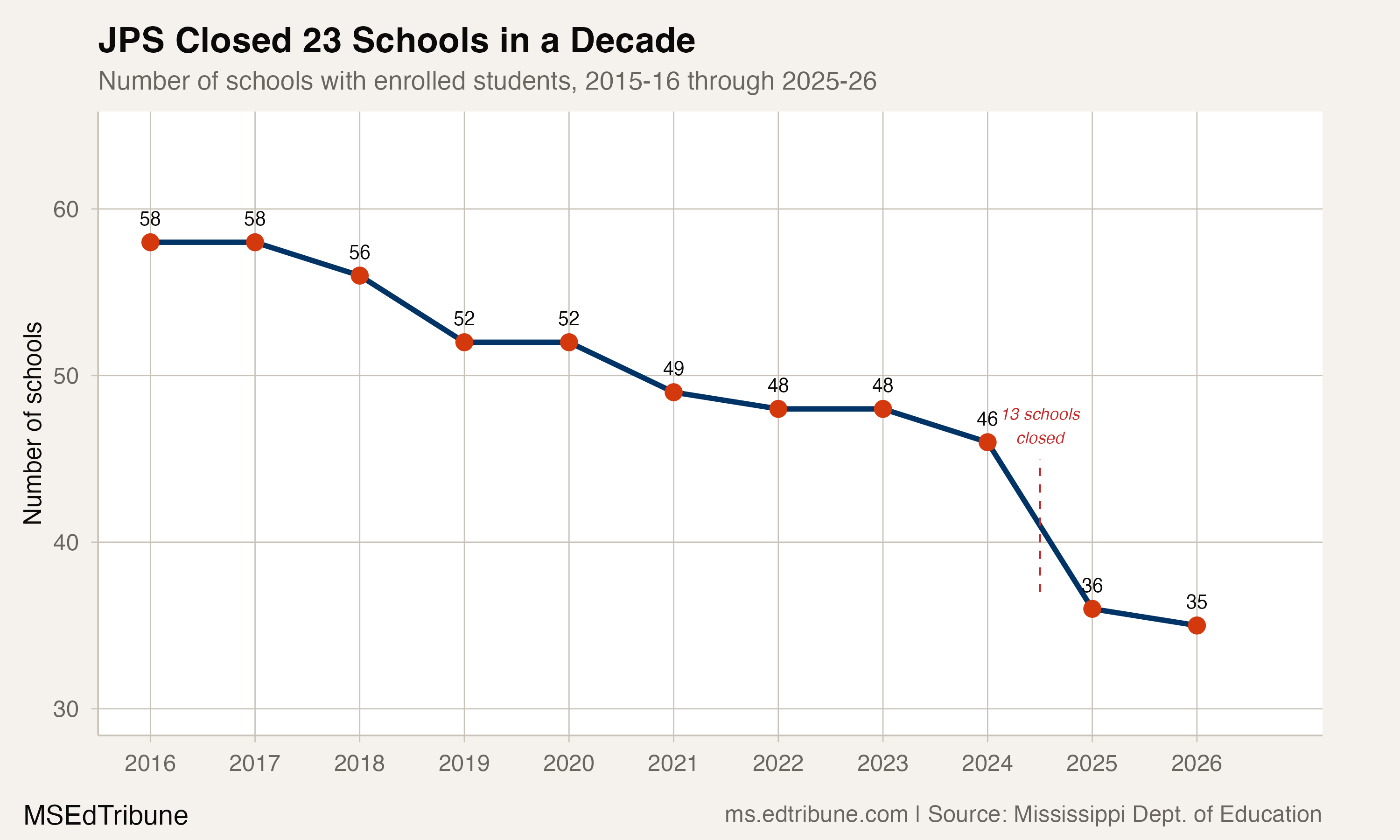
In 2025-26, Jackson operated 35 schools. The closures achieved their intended goal: average enrollment per school climbed from 386 in 2023-24 to 485 in 2025-26, essentially returning to 2016 levels (483). The district is right-sizing its physical plant. The question is whether the losses that forced the right-sizing will stop.
The $12 million annual drain
Greene's case for consolidation was financial as much as educational. According to MPB News, the district has lost approximately $12 million per year due to declining enrollment and funding diverted to charter schools. Renovation costs for the district's aging buildings would have exceeded $120 million.
Mississippi's per-pupil funding follows students. Every family that leaves takes state dollars with them. At 11,051 students lost since 2016, the cumulative funding erosion is substantial regardless of the precise per-pupil figure.
The fiscal pressure operates alongside a broader infrastructure crisis. Jackson's water system has issued hundreds of boil-water advisories, with roughly 500 issued in 2020 alone. A study published in Nature Water found that each boil-water alert caused unexcused absence rates in Jackson's public schools to spike by 1% to 10%. Schools that cannot guarantee running water face a credibility problem that compounds every other challenge.
A kindergarten class half its former size
The grade-level data reveals the structural depth of Jackson's problem. In 2015-16, 2,117 kindergartners enrolled in JPS. In 2025-26, that number is 1,113, a 47.4% decline. The kindergarten class is now half the size it was a decade ago.
Grade 12 enrollment, by contrast, has held up better: 1,627 in 2016 versus 1,389 in 2026, a 14.6% decline. The gap between entering and exiting cohorts signals that the pipeline feeding Jackson's schools is contracting faster than the overall district. Smaller 2025-26 kindergarten classes mean smaller middle and high schools for a decade to come.
One bright spot: pre-K enrollment surged from 415 in 2020-21 to 923 in 2025-26, more than doubling. Greene has made early childhood a strategic priority, and JPS now enrolls more pre-K students than at any point in the data. Whether those pre-K families stay through kindergarten and beyond will be a critical test.
Racial isolation deepening
Jackson Public Schools enrolled 286 white students in 2025-26, out of 16,968 total: 1.7%. Black students make up 91.9% of enrollment, down slightly from 96.6% in 2016 as the district's small Hispanic population grew. Hispanic enrollment rose from 433 (1.5%) to 720 (4.2%) over the decade, while multiracial students grew from under 100 to 323 (1.9%).
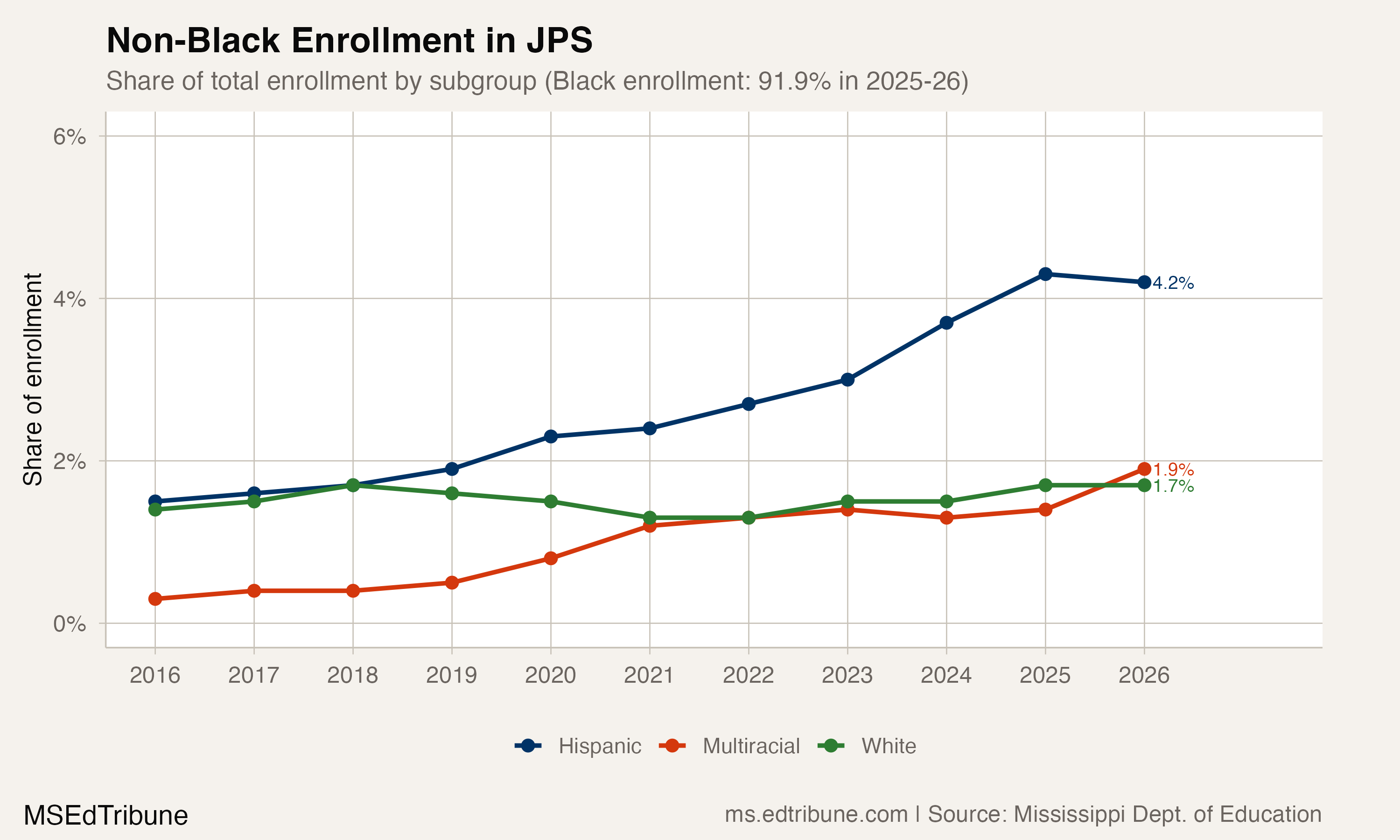
The raw numbers tell the starker story. Black enrollment fell from 27,075 to 15,598, a loss of 11,477 students, or 42.4%. The decline is not white families leaving a majority-Black district. It is Black families leaving. The city of Jackson itself lost more than 9,200 residents between 2020 and 2023, a 6.1% decline, continuing a trajectory that has seen the city shrink from over 200,000 people at its 1980 peak to under 144,000.
The surrounding suburbs tell the other half of the story. Rankin County is 60.4% white and 27.0% Black. Madison County is 43.4% white and 41.2% Black. Both districts held their enrollment roughly flat over the decade while Jackson contracted by nearly 40%.
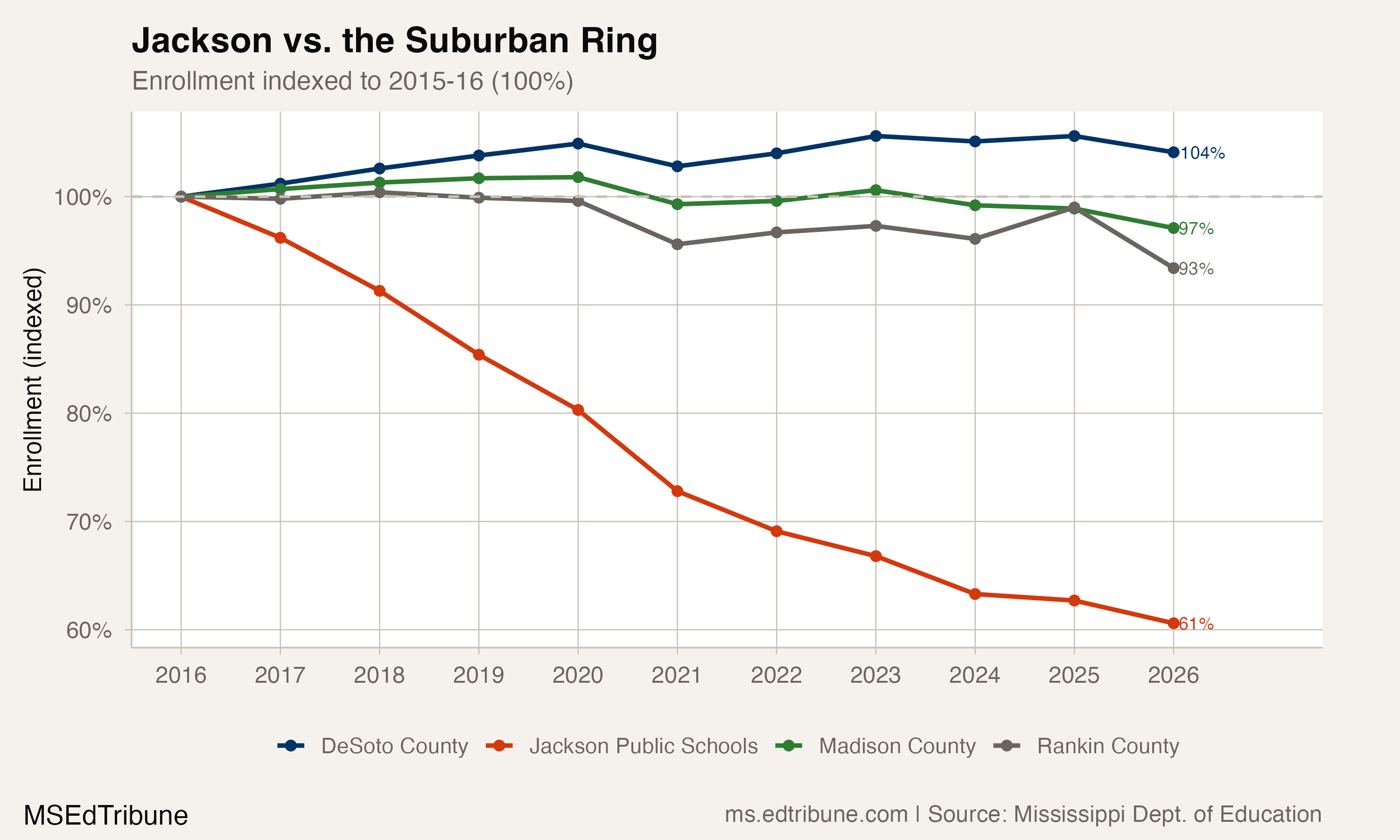
The dynamic is not new. After desegregation in the early 1970s, Jackson's white population began a decades-long exodus to suburbs like Madison and Flowood. Nearly 35,000 white residents left between 1990 and 2000 alone. Predominantly white cities in the surrounding counties grew exponentially while Jackson shrank. What is new is that the current exodus is predominantly Black families leaving a predominantly Black district and a city whose infrastructure has visibly deteriorated.
What this data cannot explain
The enrollment data does not distinguish between families who moved out of Jackson and families who stayed but chose a different school. Mississippi's charter sector is small, but charter schools in Jackson do draw students from JPS. The district itself cited charter competition as a factor in its funding losses alongside enrollment decline. The data available here has no reliable charter flag, so the share of Jackson's loss attributable to sector switching versus outmigration remains unclear.
Equally, the data contains no measure of economic status, special education enrollment, or English learner counts for JPS. The fiscal and instructional profile of the students who remain is invisible in this dataset.
Watching the pipeline
The consolidation plan bought breathing room. Average school size is back near 2016 levels. Pre-K expansion is growing the earliest pipeline. But Jackson has lost students for 10 consecutive years inside a city that has lost population for decades. This is not a cyclical dip. At the current pace, the district crosses below 15,000 before 2030, and 35 schools may again be too many. Greene's real challenge is not managing the next closure vote. It is designing a functional district at a size no one in Jackson has planned for.
Detailed code that reproduces the analysis and figures in this article is available exclusively to EdTribune subscribers.
Discussion
Sign in to join the discussion.
Loading comments...